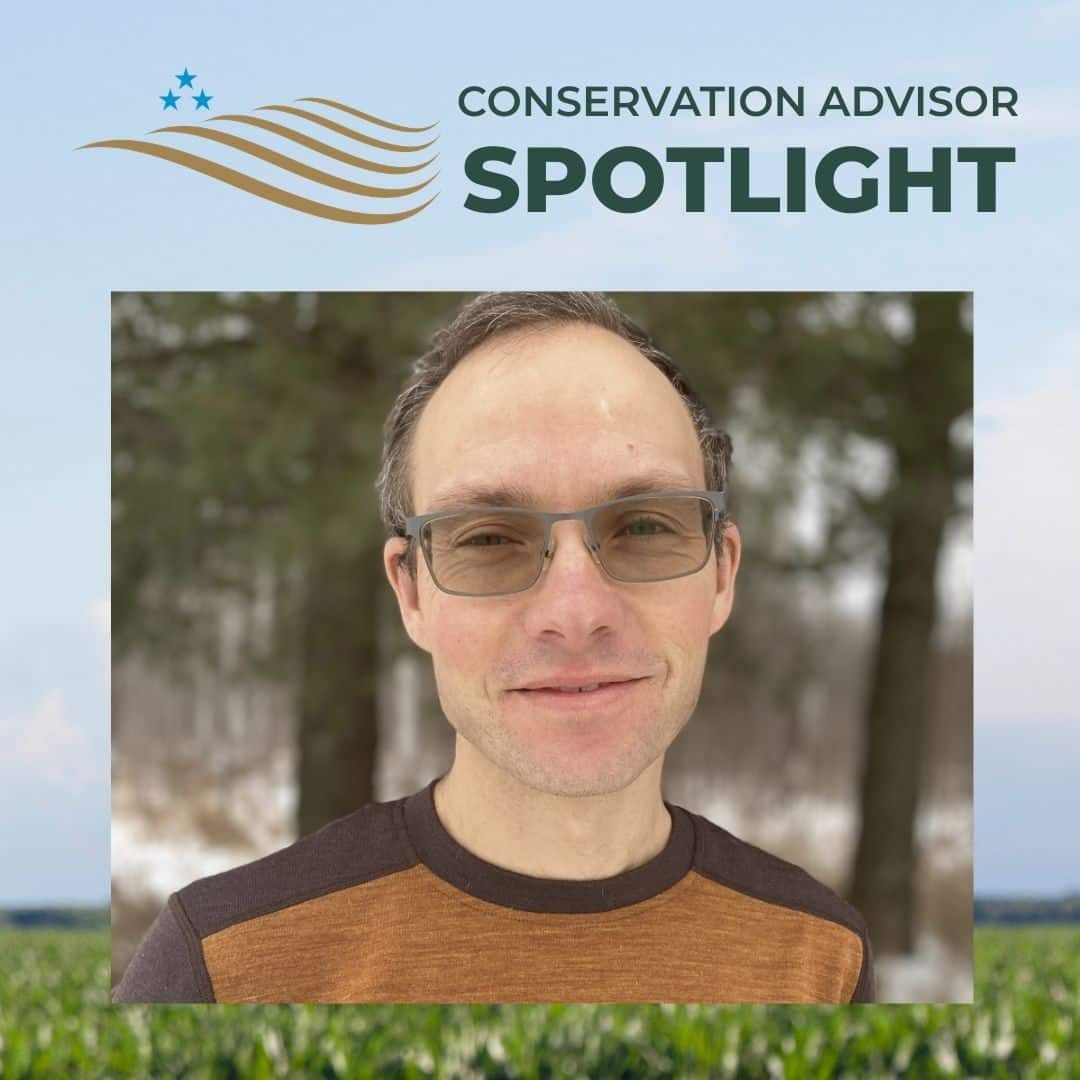
Will Bomier: Certification Specialist for MAWQCP at MDA
In Minnesota, growers are doing great things for water and climate but the public never hears about it. Through the process of certification we demonstrate to the public that there are growers taking care of the environment, and it also shows that voluntary, third-party certification does work.
Will Bomier
Will Bomier is the North Metro area Certification Specialist for the Minnesota Agriculture Water Quality Certification Program (MAWQCP) at the Minnesota Department of Agriculture (MDA). This interview has been edited for length and clarity.
What is your role with the Minnesota Department of Agriculture (MDA)?
Will: I am a certification specialist for the Minnesota Ag Water Quality Certification Program (MAWQCP). I focus on the North Metro area which includes Sherburne, Anoka, Washington, Ramsey, Wright, and Hennepin counties. I help out in the South metro too, as far south as Dakota and Carver counties.
What is your background?
Will: I grew up in Blue Earth county in a small town called St. Clair and had a sled dog habit. I had a job power washing hog barns and doing farm chores throughout high school and college. I was interested in agriculture and started my career with Natural Resource Conservation Service (NRCS) in the northern part of Michigan, and then made my way back home to Minnesota and worked for Carlton county for eight years until starting my current job at MDA. I’m a little bit strange in that I’ve worked for the federal, state, and county level governments, so I have perspective on those different levels.
What are your areas of expertise?
Will: I think my area of expertise is whole farm planning and looking at the big picture of operations to find conservation opportunities. I write a lot of nutrient management plans and stewardship plans, and all my previous jobs have dealt with manure, so I’m a specialist in manure too. I can also dive into forestry issues, and when I work together with a farmer they might discover there’s things they can do on the forestry side as well.
What does it look like for a farmer to start the certification process with you for the Minnesota Ag Water Quality Certification Program (MAWQCP)?
Will: I like to start with a conversation. Sometimes that’s on the phone, but the best ones are sitting at their kitchen table and listening to the farmer talk about their operation. The farmers are the experts of their operation and know the land better than anyone, so my goal is to hear their perspective and learn about the concerns they might have. Then we talk through their nutrient management planning in an interview style conversation. To me, it’s all about their farm goals and finding opportunities to address their concerns to make their farm more resilient.
How can a farmer plan ahead for their first visit with a MAWQCP certification specialist?
Will: Bring questions, no matter if they’re basic or complex.
The second thing that’s helpful is to be able to tell us about the nutrient management on your farm. We don’t need every detail, it can be in a basic format and written down, but it should be enough that you can explain it to us.
What are the benefits for a producer participating in MAWQCP?
Will: I think the biggest benefit is the opportunity to tell the public the good things that Minnesota agriculture is doing for the environment. In Minnesota, growers are doing great things for water and climate but the public never hears about it. Through the process of certification we demonstrate to the public that there are growers taking care of the environment, and it also shows that voluntary, third-party certification does work. As an agriculture community we all need to stand up and do a better job of telling our story.
On an individual level, it’s good to know where your operation stands with compliance of laws and regulations, and the program puts you in the driver’s seat with management practices so you can choose which things to address and the time frame to address them. It’s a good way to chart your own path and timeline, or to decide for yourself not to take anything further.
Farmers participating in the program also have access to grants and get additional points on their application when they apply for MDA’s Soil Health Financial Assistance Grant Program, which is a cost-share program for producers wanting to buy equipment for practices that improve the soil health on their farm.
What is the origin story of the MAWQCP?
Will: One of the ideas behind our program was to model the early success they were seeing with the Sage Grouse Initiative, which was launched in western states in 2010. At the time, sage grouse were going to be listed as an endangered species which would have had repercussions on the ranching community. Everyone came together and said “what if we collectively and voluntarily implemented enough conservation practices to avoid a species listing?” Enough people entered into the program so that in 2015, the Fish and Wildlife Service withdrew the proposed listing. Plus, the program offered regulatory certainty that allowed ranchers to make decisions and investments without having to worry about future regulations.
We hope to demonstrate the same type of action here in Minnesota with our water quality certification program. If enough producers step forward to get certified we might be able to avoid water quality regulation in the future. It’s also a good way for us to help educate the public that Minnesota agriculture is already implementing a lot of great Best Management Practices.
What conservation practices have been most successful in your area?
Will: I have a huge diversity of operations in my area, which is exciting because I can work with vegetable operations, orchards, or a dairy farm all in the same day. I would say that basic nutrient management has been successful on the operations I’ve seen. Often times we skip over some of the stuff that’s been around the longest, but looking at nutrient management can save producers money and help their operation become more efficient. Nutrient management also helps other practices be more successful. If you don’t have good nutrient management, certain practices like cover crops probably won’t be as successful.
A newer practice that I’ve seen success with is planting perennials on field borders along end rows. This is a practice where a farmer takes low productivity land, like the areas they drive on a lot or areas near a fence or tree rows, and plant a perennial cover on it to create wildlife habitat or reduce erosion. People who have done that are extremely happy with it. Some people are planting native warm season prairie plants, some are doing a cool season pasture mix that they can hay, it’s a fifty-fifty split depending on if they have access to hay equipment.
What advice do you have for farmers who are just getting started on their soil health journey?
Will: Don’t give up! Every field and every farm is different from the next, so what works for one person might not work for you. It’s a journey to figure out what works. We have lots of resources in Minnesota, and I feel like we’re one of the best states in the nation to help people smooth out the bumps in their soil health journey, but even with resources and extra help it still takes tweaking on the farmer’s part.
I also encourage farmers to be curious and talk to their peers and ag professionals. You can’t call me with enough questions- that’s why we’re here. The only wrong question is the one not asked. So I encourage farmers to ask questions.
Interested in working with Will to get your North Metro area farm certified through the MAWQCP? Connect with him at: will.bomier@state.mn.us or 651-895-5909
Conservation advisors work one-on-one with farmers to assess resource concerns and find opportunities for stewardship improvements. These advisors can be found at organizations across the state, from Extension offices to Soil and Water Conservation Districts to wildlife-focused non-profits. MFU regularly features conservation advisors to share how their assistance can support your farm goals. Read more in this series here.