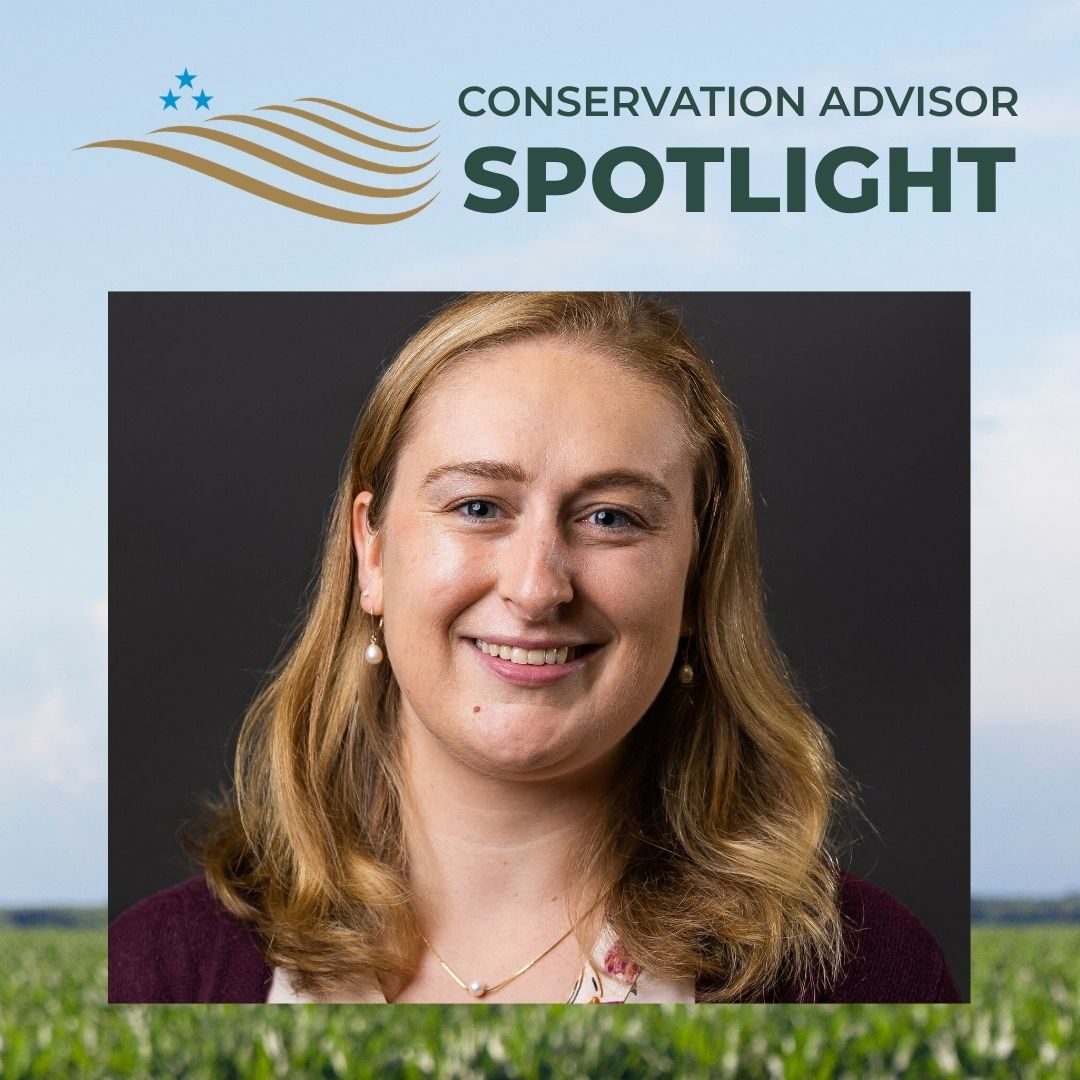
Taylor Herbert: Crops Educator at UMN Extension
Nowadays information can come from a variety of sources, so my job with these conversations is to give information that is research-based and unbiased to allow farmers to make well informed decisions for whatever management problem they’re going through.
Taylor Herbert
Taylor Herbert is a Crops Educator for University of Minnesota Extension in Wright, McLeod, and Meeker Counties. She has expertise in nutrient management. This interview has been edited for length and clarity.
What is your background?
Taylor: I got my undergraduate degree in biochemistry and originally wanted to be a pharmacist, but then realized I hated being inside all the time. After graduating I had an internship with an agriculture cooperative and I fell in love with working with farmers one on one, so I decided to go into agronomy.
I got my masters in agronomy at University of California Davis. While I was there my graduate advisor was an Extension educator, so I was exposed to what Extension does and by the time I graduated I realized that’s what I wanted to do too. I was excited about the opportunity to provide unbiased research to help farmers with their needs. I found a position with University of Minnesota Extension as a regional educator where I specialized in water quality and nutrient management. A few years later I applied and was offered my current job as the Crops Educator for Wright, McLeod and Meeker counties. I’ve really enjoyed getting to work more closely with farmers in this role for the past three years.
What does your role as a Crops Educator entail?
Taylor: Everyday is a little different, and the work also depends on the time of year. In general, I’d put my work into five buckets– the first being education. My main role is translating science and research into something useful for farmers. I take the research and slim it down into a quick two to five minute read, because farmers are busy and that’s often all they have time for.
My second bucket of work is communication. I share about specific topics and highlight upcoming events through various media channels including newspaper articles and live radio. I also have a crops newsletter that comes out once a month for farmers in the area where I share digestible and educational information.
Planning and hosting workshops is another big portion of my day-to-day work. I stay informed about my community and plan workshops based on the needs of my farmers.
I also get a lot of calls from farmers for technical assistance. Farmers contact me by calling my office or cell phone, emailing me, or they visit in person. Nowadays information can come from a variety of sources, so my job with these conversations is to give information that is research-based and unbiased to allow farmers to make well informed decisions for whatever management problem they’re going through. Extension is a free service to help farmers with answers to technical questions, and we’re not trying to sell anything to farmers.
Finally, relationship building is an important part of my role. It’s important for me to know the local advisors and agriculture industry professionals in my area so that I can refer farmers to the right people. I often refer farmers to the local Soil and Water Conservation District and Natural Resources Conservation Resource offices, as they are a very helpful resource in the area.
Do you visit farmer’s fields to provide technical assistance?
Taylor: Yes, I love visiting fields and I visit as often as I can. I often get calls from farmers that need help identifying weeds or assessing hail damage, so I go out to the farm to give a second opinion. Not all my work needs a field visit, but I prefer going out to do troubleshooting with farmers. It’s my favorite part of the job.
I also visit local farms for scouting and other research needs. Being a part of the network of Extension allows me to contribute to regional and statewide information gathering and research. The Integrated Pest Management team at Extension, for example, often has projects they want help with in greater Minnesota. This year the team is researching the soybean tentiform leaf miner to understand where it’s prevalent, so I went out to farms in my three counties and scouted for pests to send information to the team. In that way, I’m the boots on the ground resource in my region for those statewide folks. It’s nice to have relationships with farmers locally so they can be represented in data and research happening at the state level.
What type of extreme weather events have farmers in your tri-county area experienced? How have extreme weather events affected their farms?
Taylor: This year has been super variable. In June there was a long swath of hail throughout southern Meeker, the middle of McLeod and into Sibley County. I have a couple farmers I work with whose fields got hit by hail three times this summer. Hail is interesting because it can be isolated, so you could drive a mile up the road and one field is fine but another is decimated and it’s just a matter of luck. With hail this summer a couple of the cornfields were able to bounce back, but unfortunately the soybeans were completely defoliated and needed to be replanted. In response to those hail incidents, I worked together with other Extension staff to publish an article in our Minnesota Crop News blog about next steps to take after hail damage on the farm.
As far as drought this summer, Wright, McLeod & Meeker counties have seen a lot of variability too. For example, a region in Meeker County is the only part of state that never hit drought designation this summer, so it’s a sweet spot that received enough rain. However, further north where there are sandy soils in northern Meeker and Wright counties, the crops are definitely suffering. Seeing that extreme variability in a somewhat small region this summer has been an opportunity for me to learn how to educate people based on the different conditions they’re experiencing.
In recent years, have you seen conservation practices improve farm resiliency to extreme weather events such as drought?
Taylor: Soil health is a big focus of mine and I always recommend improving soil health for better resiliency on the farm. I aim to host a couple of soil health workshops a year. When it comes to soil health practices, it takes a couple years for the soil to improve and start building the microbiome and cycling nutrients effectively. People talk about yield drag when adopting soil health practices, and what research shows is that you might not get the highest yields, but you won’t get low yields either. There’s management tradeoffs but ultimately strong soil health contributes to yield consistency over time, which is the strength of the system.
I think the most common conservation practice in our area is strip-till, and some farmers are doing vertical tillage to leave 30% of the residue on the field. Cover crops are another popular conservation practice in our area. I have noticed that farmers implementing these practices have reduced soil erosion. This spring there were quite a few dust storms in parts of Meeker County and that opened people’s eyes that soil erosion is a big concern because there was so much soil blowing around.
What conservation practices do you have most expertise in?
Taylor: My background is nutrient management, so when it comes to soil health practices that’s my expertise. With conservation practices, a common question farmers ask me is whether to apply additional nitrogen when incorporating cover crops into their rotation, and generally I tell them not to. With nutrients for cover crops it’s more important to shift to applying nitrogen fertilizer up front before mid spring when the soil microbiome starts to cycle and cereal rye breaks down. Making sure people know to put nitrogen on their fields earlier in the season with cover crops is important, and common advice I give.
What resources do you recommend to farmers who want to implement conservation practices or become more resilient to extreme weather events?
Taylor: One of the great things in my area are the Soil and Water Conservation Districts. I often connect farmers with those offices for technical assistance or financial resources. I really like to highlight local partners.
Another helpful resource I recommend is the Midwest Cover Crop Council. They have great recipes for cover crops for beginning farmers, a cover crop selection tool, and agronomic considerations for each cover crop. If farmers are nervous about implementing cover crops for the first time it can be reassuring to have a plan, and the Midwest Cover Crop Council does a really good job of outlining that.
I also recommend farmers learn from each other, because in my experience farmers are willing to share their experiences. Finding an Extension educator to connect you with someone doing a practice you’re interested in to be a mentor can be really helpful. Farmer to farmer education is often more impactful than professional technical assistance. Attending events such as U of M Extension’s Soil Management Summit is a great way to meet and hear from farmers about their experience with conservation practices.
What are you looking forward to during the end of the 2026 growing season?
Taylor: One fun event I’m looking forward to is delivering harvest buckets to farmers. At the end of September to early October every year, the Hutchinson Chamber of Commerce Agribusiness committee delivers harvest buckets full of snacks, first aid kits, and anything else that area businesses want to donate to farmers to show appreciation for them. Harvest requires long days so I really enjoy handing out harvest buckets to farmers to give them a boost.
How can people stay in touch with your work at Extension?
Taylor: I post our Soil Health workshops and other events on the Meeker, Wright and McLeod county newsletter and on the Facebook page. People can also find events on the extension events page. The Extension Crops Newsletter is another great way to stay in touch.
Interested in connecting with Taylor for technical assistance for your crop farm? Connect with her at: therbert@umn.edu or 612-394-5229
Conservation advisors work one-on-one with farmers to assess resource concerns and find opportunities for stewardship improvements. These advisors can be found at organizations across the state, from Extension offices to Soil and Water Conservation Districts to wildlife-focused non-profits. MFU regularly features conservation advisors to share how their assistance can support your farm goals. Read more in this series here.