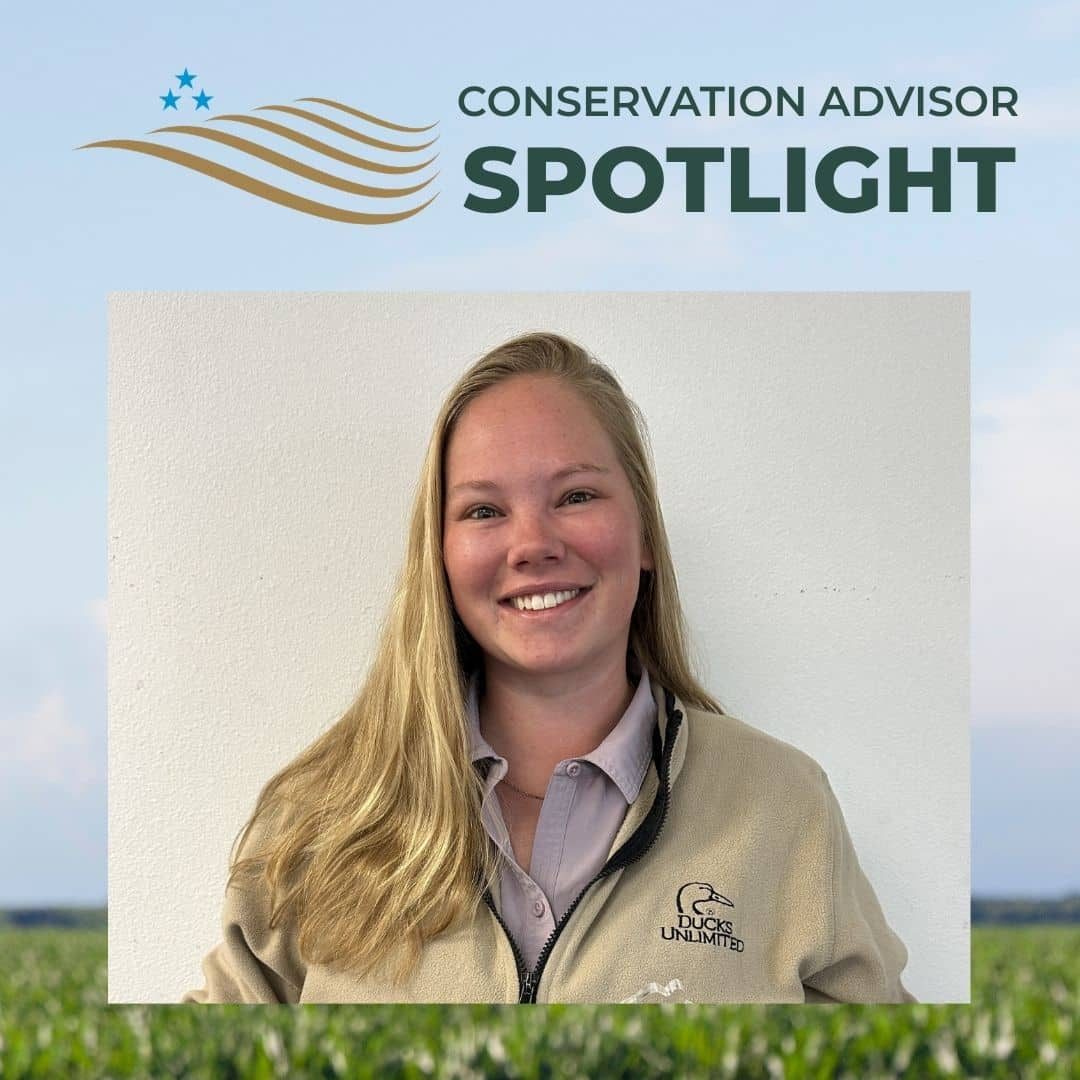
Sabrina Claeys: Grazing Biologist at Ducks Unlimited
Getting to see those producers I’ve worked with be examples for the management practices they’ve done has been rewarding.
Sabrina Claeys
Sabrina Claeys is a Grazing Biologist at Ducks Unlimited. She works in Northwest Minnesota and is based in Thief River Falls. This interview has been edited for length and clarity.
What counties do you work in?
Sabrina: I am located in Thief River Falls, way up in the northwest corner of the state. I cover 12 counties from the Canadian border down to Detroit Lakes and as far west as the North Dakota border.
What is your background?
Sabrina: I didn’t grow up in ag, but I’m a wildlife nerd at heart. My Bachelor of Science is in wildlife ecology-resources and management from the University of Wisconsin-Stevens Point. I started my career as a Farm Bill Biologist down in Louisiana for Quail Forever. For three years I was working on forestry management for Bobwhite Quail. This job at Ducks Unlimited opened, and I always had a fascination for grazing management and how that intersects with wildlife habitat. I’ve been with Ducks Unlimited for almost three years now. At first, information came at me like trying to drink out of a fire house, so I had to learn quickly, but that’s been the fun part. My focus is working with livestock producers to implement sustainable farm management practices that benefit our soil quality, water quality and wildlife habitat. When we have sustainable grasslands and pastures through good grazing management, we see these benefits over time.
What are your areas of expertise?
Sabrina: My strong suit is helping people navigate what they haven’t done before, and I specialize in helping farmers find management practices to complete their goals. I feel like a jack of all trades rather than an expert in anything. If a producer’s objective is to improve soil quality, I try to find different management practices to accomplish that. I’m a problem solver in that sense. I work a lot with native forages, like warm season grasses and forbs. From an organizational standpoint, Ducks Unlimited’s number one priority is waterfowl habitat, but in reality, creating good habitat for one species ends up being good for the whole
ecosystem.
What does a visit with you look like for a farmer?
Sabrina: We set a time, and we meet right at the farm gate. Some producers are looking for technical assistance for programs like EQIP. I ask a ton of questions about their goals and objectives for their operation in five, ten and fifteen years. We talk about what they are struggling with and how to incorporate management practices to improve those weak points. It’s usually a long-winded, two-to-three-hour conversation while driving around their pasture and looking for places to make improvements. As a grazing biologist, I often don’t talk to producers about wildlife habitat. Instead, I might talk about water quality and improving forage on their operations, which come with wildlife and environmental benefits, but I feel like I wear more of a producer hat than a wildlife biologist hat when I talk to folks. We want our management to work for the producer, their bottom line, and their operation.
How can a farmer plan to get the most out of a visit with you?
Sabrina: A farmer can prepare by just being honest with themselves and thinking about where the weak points are in their operation and where they’d like to see things improve. I encourage them to think long term about who will take the operation over in the future. It’s also important that the producer can be vulnerable with people and allow them to help. I tell people to dream big with their goals and we can slowly but surely tackle those with technical and financial assistance.
What are the benefits for a producer working with you at Ducks Unlimited?
Sabrina: A producer working with Ducks Unlimited can take advantage of a free service to get ideas for their operation. It’s always good to have a second set of eyes and another person to talk to about your farm, and it’s completely free to give us a call and have us come out to your farm. Our technical assistance and partnership with NRCS is strong and sometimes working with us can turn into a plan for potential financial assistance. We have a team of 20 other people besides me here in the state. We have an engineering team and a conservation team who work on grazing and grassland easements across the state. I’m just one spoke of this wheel.
What programs or conservation opportunities have been most successful in your area?
Sabrina: I’ve been working for Ducks Unlimited for about three years, and I finally get to see results. This work takes time. Successes so far have been walking producers through EQIP and other programs to build infrastructure, implement new practices and overall seeing tremendous gains. I enjoy asking folks I’ve worked with how everything is going or how the programs have helped them and they say, “it’s great and just what I needed to jump start the operation.” Getting to see those producers I’ve worked with be examples for the management practices they’ve done has been rewarding.
Last month we held an educational event for alternative forages in partnership with the Northwest Stockmen’s Association, and it was a great day. We had a producer who previously had the idea for season long cover crops who I helped walk through the EQIP process by creating seed mixes and a grazing plan. Soon enough, he was off to the races. At the event he talked about grazing the cover crops which will give him another month or so of feed. It pays to have even just a small idea.
Ducks Unlimited also has a new program that’s fresh off the press: our native forages program. The goal is to diversify the forage type on operations to create drought resiliency during the summer months when pastures are shot, and to reduce the need for alternative supplemental feed. We’re trying to incorporate native warm season grasses back into operations and converting cool season pastures like orchard grass pastures back to the natives. We are doing all of the site preparation and seeding for the program, so it’s a no effort signup for the producer. We’re aware that natives take a long time to establish which puts producers in a bad spot for two years before they can graze it, and we want the program to be successful. We’re compensating with a deferral payment of $200 an acre to offset the economic cost while those natives are established. A grazing specialist will write a solid grazing plan for the operation and help the producer learn how to graze the land in the years ahead.
What advice do you have for farmers who are just getting started on their soil health journey?
Sabrina: I have two big things I like to tell farmers. First, don’t be discouraged when something doesn’t work right away. Soil health takes time, Rome wasn’t built in a day, and all of those other clichés. For example, you can’t plant one cover crop and see change in one season, it takes a lot of time. Sometimes we are working against mother nature and there’s not enough rain for the cover crops to establish, so don’t be discouraged.
The other advice I have is to pick a field, paddock or a small portion of your farm and implement the new practice to the best of your ability on that section instead of making a big change all at once. It’s a good method to start with to see how you could replicate it on your entire operation. Taking information all at once will make you feel overwhelmed. Take it one step at a time and go from there.
Interested in working with Sabrina to improve your grazing management? Connect with her at: sclaeys@ducks.org or 563-221-1009
Conservation advisors work one-on-one with farmers to assess resource concerns and find opportunities for stewardship improvements. These advisors can be found at organizations across the state, from Extension offices to Soil and Water Conservation Districts to wildlife-focused non-profits. MFU regularly features conservation advisors to share how their assistance can support your farm goals. Read more in this series here.