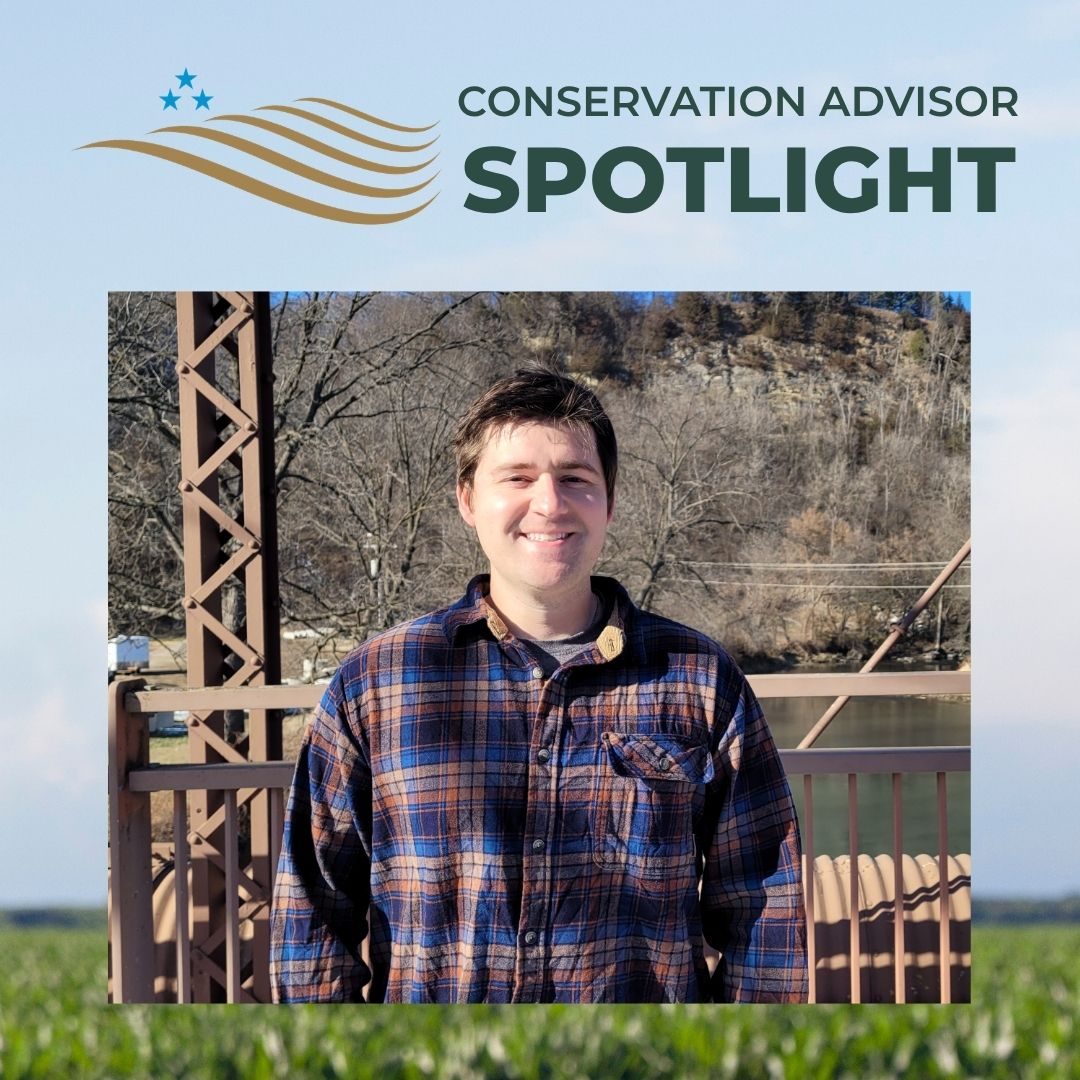
Riley Buley: District Manager at Fillmore SWCD
I’ve worked in other states that don’t have the same resources as Minnesota, and I’ve realized that in this state we’re blessed to have resources that people can go to for conservation.
Riley Buley
Riley Buley is the District Manager at Fillmore Soil and Water Conservation District. He has a background in water resources. This interview has been edited for length and clarity.
What is your background?
Riley: I grew up in Mankato going to my grandparent’s farm in Sleepy Eye, which was always a highlight. My connection to agriculture is from that experience along with my background in aquaculture. I became interested in water resources during high school and decided I wanted to pursue that, so I went to University of Wisconsin La Crosse and studied aquatic sciences. I worked on invasive species such as Asian carp moving through the Mississippi River for the geological services while I was in La Crosse, and I also got to know the driftless area and fell in love with it.
Later I got my doctorate in water resources, fisheries and aquatic sciences at Auburn University in Alabama where I learned a lot about harmful algal blooms. I also got to work with catfish farmers because water quality is a big thing for them. Afterwards I worked for two Tribal governments in Iowa and Wisconsin for water quality, but realized I wanted to get back to the driftless region in Minnesota, so I started looking for a leadership or management position. That’s when this position as the District Manager at Fillmore SWCD opened up and they took a chance on me. It’s been great, and I’ve been learning as I go.
What types of farms are there in Fillmore County?
Riley: There’s a wide diversity of production systems in our area. We have typical corn and soy rotations, and we have a lot of hay and livestock operations as well. Contour farming is something that happens in our area that is perhaps different than other parts of the state.
What is your region experiencing in terms of extreme weather?
Riley: There seems to be rain events with a lot of precipitation going down at once, followed by lengths of dry spells. Looking at it through a conservation lens, rainfall events becoming more extreme can lead to more significant erosion of soil and nutrients into waterways. There’s research by the Minnesota Department of Agriculture about erosion entering waterways during the spring thaw, and it’s striking that during these freeze/thaw cycles is when we see a lot of nutrients leaching into waterways.
What conservation practices are your staff experienced in helping farmers with?
Riley: We have staff experienced in nutrient and manure management, along with structural practices such as engineering grassed waterways and grade stabilization structures, which are practices that are in demand here.
Some of our staff are working on water quality in the Root River by taking samples of the water and sending them for testing. We also test landowner’s well water at our in-house lab– our staff is accredited for testing E.Coli, and can run non-accredited nitrate screenings of well samples too.
Other common practices that we assist producers with at Fillmore SWCD include cover crops, reduced tillage, no-till, conservation rotations, and prescribed grazing. We’ve seen farmers turn marginal row crop acres into whole grazing systems by switching to prescribed grazing.
What types of conservation programs do you have at Fillmore SWCD?
Riley: In terms of our programming, Fillmore SWCD holds funding and is the manager for One Watershed One Plan for the Root River, which is a comprehensive watershed management plan. We were one of the first watersheds in Minnesota that received funding from Minnesota’s Clean Water Fund for conservation practices. We will be revamping the watershed plan and our goals over the next ten years to solidify the conservation practices we want to get on the ground in our watershed.
In partnership with the Minnesota Department of Agriculture, we also have programs called the Township Walkovers and Field to Stream Partnership. Through these programs we do farm walkovers in high nitrate townships to help landowners implement nitrogen reducing practices and address erosion. This often involves SWCD staff taking soil samples and creating holistic plans for nutrient management on farms. Our district has expertise in nutrient and manure management, so we are well versed in helping producers decide on the best rate and timing for nutrient and manure applications.
Another big program we have at Fillmore SWCD is the Alliance to Advance Climate-Smart Agriculture, which was launched in 2024 with the goal of putting thousands of acres into soil health practices, capture carbon, and compensate farmers for annual ecosystem services regardless of their previous experience with these practices. As of 2024, our staff have assisted producers in implementing 30,000 acres of nutrient and manure management practices through the program, which really shows the interest that both livestock and row crop producers have in Fillmore County.
Can you share more about the Virginia Tech Alliance to Advance Climate-Smart Agriculture program at Fillmore SWCD?
Riley: Minnesota has eight SWCD’s involved in Virginia Tech’s Alliance to Advance Climate-Smart Agriculture program, including Fillmore.
In the beginning, we sent post cards to all producers in the county with 3 acres or more. We followed up with an informational meeting and had 125 people attend, which caught us by surprise. We also sent neon orange programs to people in the mail, and after that people started coming in to ask us about the program. We even had landowners talking to their renters about enrolling the program.
Currently there are hundreds of participants enrolled with over 60,000 acres of soil health practices being implemented on the land. Some producers in the program are experienced in conservation, but others were new to us and are just getting started. It has been great to get new people in the door to talk about soil health and conservation. There’s not one silver bullet for all farms and each farm will need practices tailored to their system and landscape.
Are there other organizations in your area that farmers can receive assistance from for conservation practices?
Riley: When we connect with producers we don’t necessarily need to enroll them in one of our programs at Fillmore SWCD, we can also connect them to non-governmental organizations, or even help them work on their own to resolve whatever issues they may be having on their land. I’ve worked in other states that don’t have the same resources as Minnesota, and I’ve realized that in this state we’re blessed to have resources that people can go to for conservation. In our office we can get conversation started and lead people to more resources.
There are a few organizations that have worked with producers in our area. We recently had a cover crop program from Conservation Technology Information Center (CTIC) come across our desk with the goal to enroll a couple hundred thousand acres. Farmers have also signed up for programs through Practical Farmers of Iowa, and we know pork producers who have worked with Ducks Unlimited. The Minnesota Soil Health Coalition has also engaged with farmers on conservation practices.
What would you say to a farmer that is concerned about return on investment for conservation practices?
Riley: Return on investment is something we talk about during our farm walkovers for the Township Walkovers program. With our walkovers the goal is to provide landowners with an array of options of conservation practices to integrate into the system, including low investment and high investment options. With a whole-farm planning approach, we can talk about capital and solutions that can be done now versus what we can be done later depending on the farmer’s financial situation. There are certain changes that are investments the landowner has to make, and other changes that the SWCD can provide cost-share financial assistance for.
What are you looking forward to in the 2026 growing season?
Riley: I’m excited to see the progress of our work getting more conservation practices on the land through our various programs. The state of Minnesota has prioritized soil health recently, and it feels we are seeing the fruits of that labor unfold which is great. I look forward to continue seeing farmers’ progression with soil health.
How can farmers stay in touch with Fillmore SWCD?
Riley: We have a newsletter that comes out once a year in our local newspaper, the Fillmore County Journal. We repost that newsletter to our website, fillmoreswcd.org. Our website is where we keep people up to date with what we do, and where people can find the staff members that are involved with each of our programs to help with practices they’re interested in.
Interested in working with staff at Fillmore SWCD? Connect with Riley at: 507-887-0241 or riley.buley@fillmoreswcd.org.
Conservation advisors work one-on-one with farmers to assess resource concerns and find opportunities for stewardship improvements. These advisors can be found at organizations across the state, from Extension offices to Soil and Water Conservation Districts to wildlife-focused non-profits. MFU regularly features conservation advisors to share how their assistance can support your farm goals. Read more in this series here.