Morgan Kauth: District Conservationist for NRCS
The biggest success stories are always watching light bulbs go off in people’s heads that the ‘crazy’ ideas aren’t as crazy as they think.
Morgan Kauth
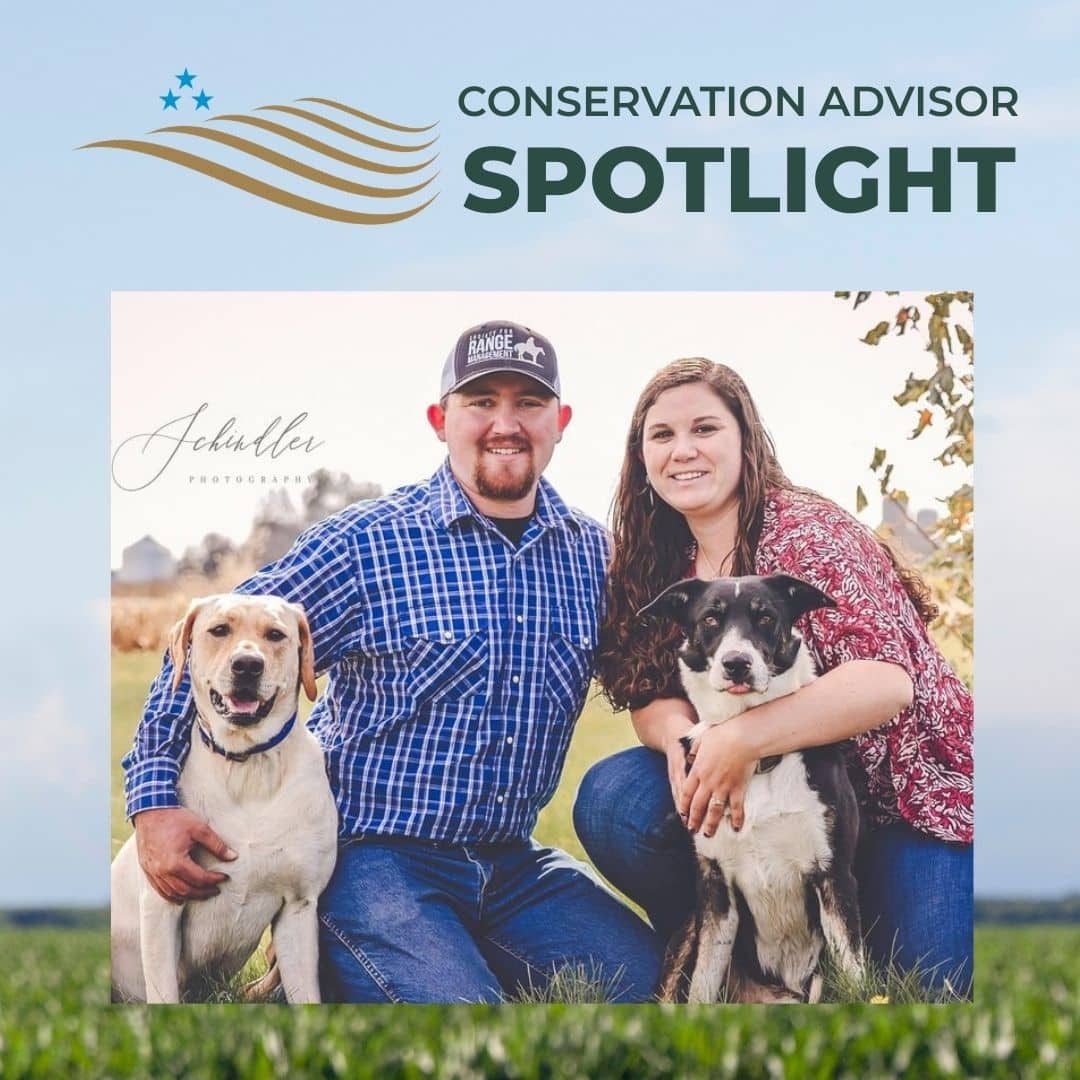
Morgan Kauth is the acting District Conservationist for Natural Resources Conservation Service (NRCS) in Big Stone County. He is also a board member of the Minnesota Grazing Lands Conservation Association (MNGLCA). He specializes in grazing and grasslands. This interview has been edited for length and clarity.
What is your background?
Morgan: I was born and raised in Nebraska and grew up in the agriculture community. I grew up doing FFA, livestock judging, and competitions. My dad’s a conservationist, so as a kid everything was about borrowing the land from future generations and making sure the land gets to the future generations. I went to SDSU for fisheries management and then got a masters degree in rangeland management. Then I worked in the private sector doing livestock and grazing. I call myself a prairie fairy, I love grasslands and I’m a big believer in warm season grasses. I’ve always loved the outdoors and would rather be outside than inside, but I don’t farm enough to make that my full-time gig.
My wife and I own a small cow-calf herd alongside my father-in-law. We buy our hay and rotationally graze and custom graze cattle. The cows are moved weekly or even daily on rented public land from the Minnesota Department of Natural Resources (DNR) and the US Fish and Wildlife Service. We bring in custom calvers and run them alongside our cows, which is a great way to improve grazing and cash flow, and a great way to offer care for others. This way people don’t have to worry about minerals and other things, it’s a full-service deal. We also raise up to 150 pasture broiler birds in chicken tractors, and we have a tractor of 50 laying hens. All our broilers are sold by word of mouth, and we have an egg hut at the end of our driveway.
How long have you been in your current role with NRCS and Minnesota Grazing Lands Conservation Association (MNGLCA)?
Morgan: I was hired by NRCS in 2021 as a rangeland management specialist at a local field office in Minnesota, then I got my current position as the southwest area grazing specialist in Minnesota, covering 19 counties. For almost a year I’ve also been the acting district conservationist in Big Stone county, but my specialty is grazing and grasslands.
A few years ago I got asked to be on the board of the Minnesota Grazing Lands Conservation Association while I was working as a consultant for the South Dakota Grassland Coalition. I was excited that Minnesota was doing the same work as South Dakota with pasturelands. Pastureland and grassland acres are usually undervalued, so I thought joining the coalition was a great way to be part of a group for managing pastureland and promoting conservation. I sort of just fell into the role.
How does your role with NRCS complement your role with MNGLCA?
Morgan: My roles with NRCS and MNGLCA complement each other because NRCS has great opportunities for cost-share and technical resources for farmers, but MNGLCA can take that a step further through education and outreach. Talking to the government can sometimes be intimidating for people, but with MNGLCA all the people involved are farmers, so that gives farmers the opportunity to learn in a farmer-to farmer setting. MNGLCA is like an encyclopedia of knowledge for the actual practitioners, and that helps bridge the gap between farmers and NRCS.
The farmer-to-farmer network of MNGLCA also helps me have more impact on the ground by connecting me with people in the same circle. It’s sort of a self-screening tool. People have reached out to me to bounce ideas off of me or if they need a little nudge from a friend. Some people know I have a chicken tractor and want to learn more about that. Or a neighbor will drive by a field and see a practice they want to learn more about, and my number gets passed around that way.
Do you meet one-on-one with producers to provide assistance for conservation practices?
Morgan: Yes, that’s a big part of both my roles. Whether that’s on the phone, by email, or coming to the office, there’s usually an initial contact with farmers that leads to a face-to-face meeting on their farm. My work tends to be one-on-one. Some people are more comfortable learning in groups and will go to outreach events for MNGLCA, but a lot of people are more comfortable being on their own farm or even coming to my farm to see what I’m doing. I’ve had people come out to my rented land a couple times a year to see how we’re managing it, and my wife can talk about the animal science side of things.
Does a farmer need to prepare beforehand or bring anything to a meeting with you?
Morgan: There’s not necessarily anything farmers need to prepare before a meeting, but it’s good to think about your goals and priorities. I very much believe that you need to be intentional to reach goals. People usually have a ton of ideas, but if you make every idea a priority, then they really are not a priority. So for example if you want to add oats to your operation, you have to think about where they will work on your farm, and where you will get seed, and what you want to get out of the crop, like straw or grain. Once you know those things then you can start taking steps to have oats that will work on your farm for straw production, for example.
What practices have been most successful for farmers you have worked with?
Morgan: The biggest success stories are always watching light bulbs go off in people’s heads that the ‘crazy’ ideas aren’t as crazy as they think. Most of the folks I work with have a light bulb moment at some point along the way. In one instance, I worked with a producer who was rotationally grazing with weekly moves, and he was doing quite a nice job. But he complained to me that he was short on grass and didn’t want to try polywire because he preferred hard fences. I told him to think about how polywire could make smaller paddocks on his pasture to help him gain extra days for grazing, and I think he originally thought I was full of crap. But he went out and got a polywire wheel and put his cows on 3/4 acre paddocks and started moving them more often. From that change he said he gained 90 extra days of grass. He still has all his hard fences up on the perimeter of his pastures, but now he moves the cows more often. I always remind him about when he was totally against polywire and didn’t see the value of intensifying his management. In the end he felt like it was an improvement and a worthwhile change.
In another instance, my friend up the road was insistent on using five-strand barbwire for his cattle, and he was telling me about the difficulty of haying his hills and that he needed a change. I showed him my herd, and it totally blew his mind that I could keep my cows inside a paddock with a single strand. He also saw that everywhere where cows left manure the grass was more lush. After that he wanted to try polywire, and from that experience he learned more about how cattle and wildlife management kind of go hand in hand.
What advice do you have for farmers who are just getting started on their soil health journey?
Morgan: You just have to start. A lot of the people I’m talking to have already figured out where to educate themselves, but sometimes we get paralysis of knowledge by reading big names like Gabe Brown and gaining all this knowledge. It will daunting at the beginning, but you have to just start because no one will know your farm like you do.
Agriculture is rooted in tradition, so sometimes it’s hard to break away from norms. But once you start making management changes you will figure out your comfort level with being uncomfortable. The first time you rotationally graze your cattle it’ll be a little bit of a circus, but the once you go from continuous grazing to moving cattle once a month, those cows will start picking up on the patterns.
Interested in working with Morgan on your grazing plan? Connect with him at: morgan.kauth@usda.gov or khartcattle@outlook.com or 402-841-5532
Conservation advisors work one-on-one with farmers to assess resource concerns and find opportunities for stewardship improvements. These advisors can be found at organizations across the state, from Extension offices to Soil and Water Conservation Districts to wildlife-focused non-profits. MFU regularly features conservation advisors to share how their assistance can support your farm goals. Read more in this series here.