Legvolds implement no-till to save time and keep raising the bar on conservation
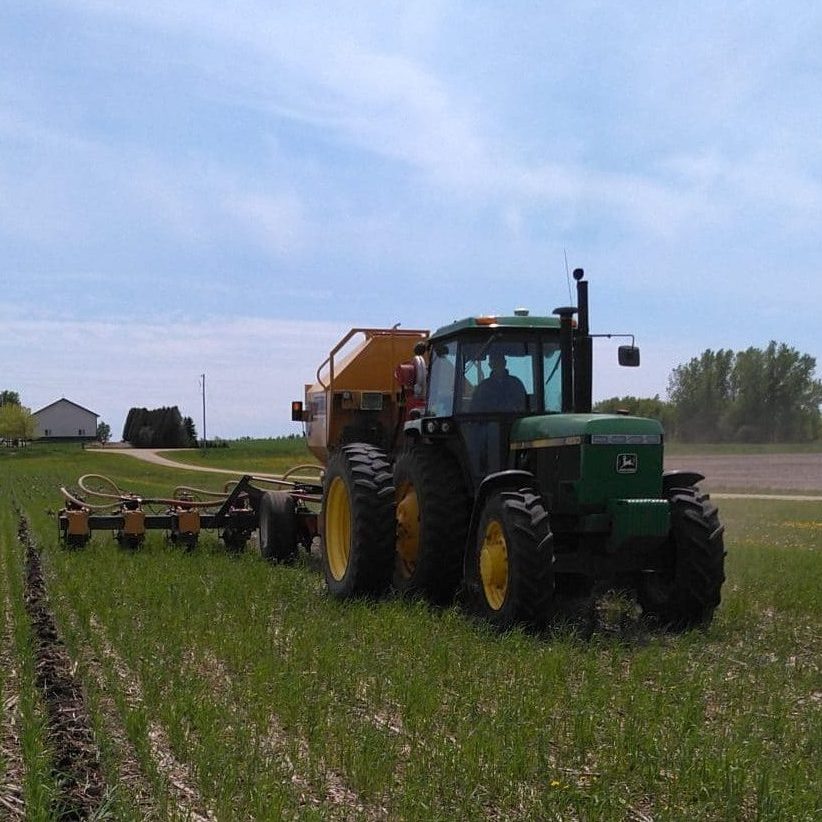
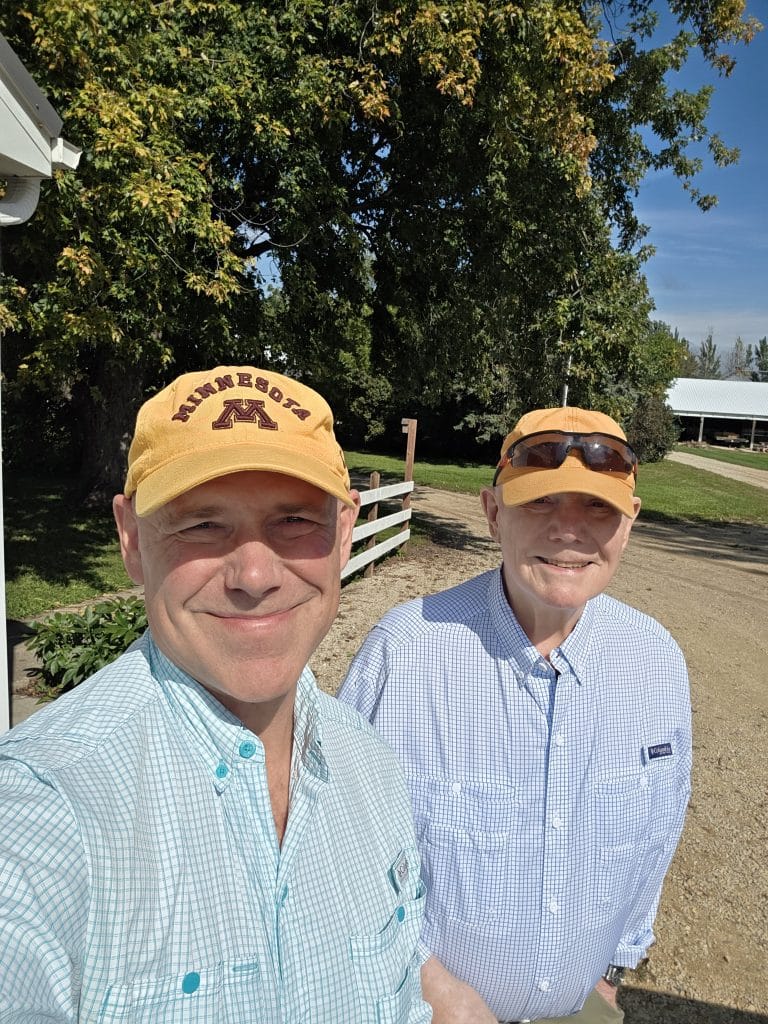
Father and son Dave and Mark Legvold raise corn, soybeans and cereal rye on their 650-acre farm in Dakota and Rice Counties near Northfield. The Legvolds were early adopters of soil health practices, and they educate about their conservation practices by speaking at and hosting field days.
Dave is a retired school teacher of 35 years, and Mark is an Air Force veteran.
This conversation has been edited for length and clarity.
What is the history of your family farm?
Mark: My dad and mom moved to Northfield in 1976 and built the house on the site where we’re at now. Dad was a school teacher, so he was commuting up to Richfield from Northfield every single day and then farming on the side. We had beef cattle, hay, corn and soybeans. His hope was to start running things organically not using any synthetic fertilizer, which is a real labor-intensive way of doing things.
I worked alongside dad on the farm as I was growing up and then graduated high school, left for college, and served active duty in the Air Force away from Minnesota for five years. My brother also left and went to college so the labor pool shrunk and dad was still commuting.
At this point, dad needed to find a more efficient way of doing things. He heard about this great idea called no-till, and around 1990 he did an experiment by renting out the no-till drill from the county to do no-till beans, which looked awful back then, because we were used to clean fields with no crop residue, and weeds needed to be managed differently. However, they yielded really, really well with less labor. That was a time saver, so he kept on doing that.
Eventually I moved back to Minnesota, to Northfield, and I sectioned off five acres of the family farm to raise my family where I grew up. That’s when dad and I started farming a lot more together.
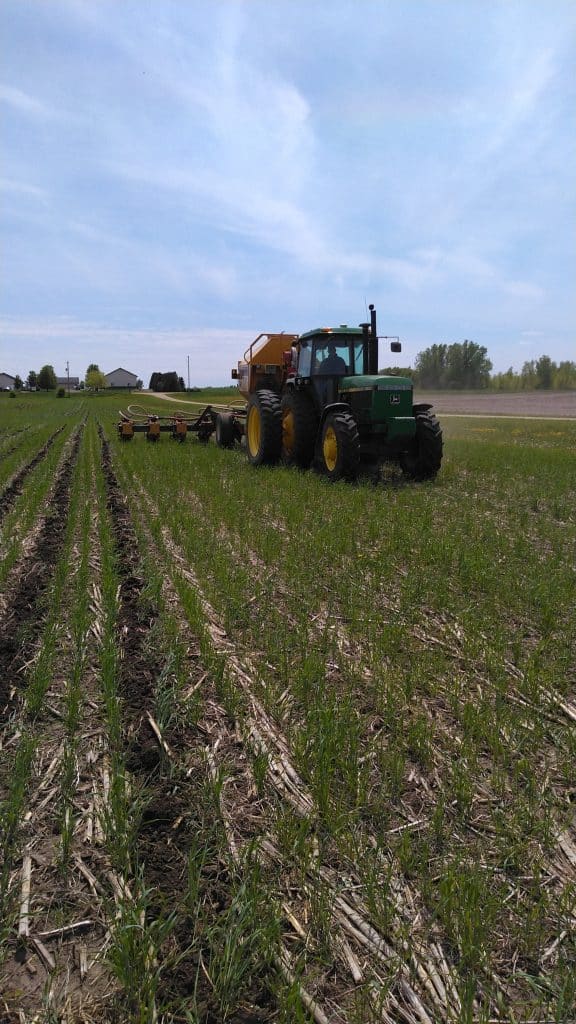
Now, my dad has a good piece of equipment in the soil warrior (strip-till machine) and no-till planter, and that type of reduced tillage operation has been going very well for us. We also implement other conservation practices on our farm. We split apply our nitrogen, so one application granularly at planting season, and then we sidedress a liquid dose when the corn reaches about V3 to V5. I thought we should experiment with interseeding some cover crops into that, so we’ve been adding cover crops to our operation for about a decade now and working extensively with that. Around 2011, I designed a way of applying cover crops by fixing the broadcast seed spreaders right to our tool bar, so we add cover crops to corn at the same time that we sidedress our nitrogen. Then we started planting cereal rye after we harvest our soybeans about five years ago. Our two-year rotation is strip-till planted corn, then a diverse cover crop mix including rye and tillage radish, then no-till planted soybeans, then cereal rye.
Can you speak to any difficulties in the process of establishing these soil health practices on your farm?
Mark: One of the biggest difficulties is having a good relationship with your agronomist to figure out how to apply the right amount of herbicide. We want to minimize our use of herbicide as much as possible, because we don’t want a long residual when killing off weeds in the corn so that the cover crops will grow. Finding the right balance between enough herbicide to reduce our weed pressure while allowing our cover crops to grow is one of the difficulties. It takes good observation, and you have to be diligent in managing your fields. Building that relationship and learning together can sometimes be challenging. I’m glad ours is open to learning alongside us.
Has adopting soil health practices made your farm more resilient to extreme weather events?
Mark: Yes, one of the good things about applying cover crops and not tilling is that your soil becomes much more resilient to these big weather events, and it’ll store water a lot longer. Water doesn’t run off as quickly when you have organic matter and complex soil structure from good biological activity under the ground.
The other great thing with the improved soil structure is that we’re able to get out into the field a lot sooner after a rain event than a farm that’s been conventionally tilled. Conventional farming will turn the top couple inches of soil into dry powder that turns to muck, which makes tractors get stuck. In contrast, on our farm we can go out and float right through that stuff because the soil is complex enough to hold up the tractor.
Have you seen other benefits from adopting soil health practices on your farm?
Mark: The other benefit has been saving time and reducing equipment costs. I did research and compared Iowa’s custom rates to the way we farm. Over the course of two years, it costs us about $100 less per acre to farm the way we do compared to doing it conventionally. And by the way, that includes rock picking, which we don’t have to do so there’s good cost savings there.
What do you wish the average person understood about climate-smart agriculture?
Mark: I think there’s a lot of folks that that believe that farmers are a big part of the problem when it comes to the way the climate is behaving. Those people are very thoughtful about organic crops being healthier, and they make the conclusion that all farmers who aren’t farming organic are farming poorly. The binary thought process can really be the downfall to any kind of critical thinking.
We are not an organic farm, but my dad and I farm in a way that allows us to be certified with the Minnesota Agriculture Water Quality Certification Program (MAWQCP). We do a whole lot of soil, water, and air quality management practices that, quite frankly, are a big solution to the problems that we’re seeing in climate. Farmers can be a solution to climate change by switching just a few practices. For example, if every farmer parked their plow or didn’t do deep ripping in the fall, there would be less dust in the atmosphere, our water quality would improve, and there’d be less carbon in the atmosphere. I think the biggest misconception that people have is the amount of impact that farmers can have positively on the environment.
What are some market and policy opportunities you are keeping an eye on?
Mark: One thing I’m keeping an eye on is the Soil Health Financial Assistance Program, which is MDA’s program that allows farmers to apply for a grant to defray the costs of switching from conventional tillage to soil building practices. The money in that account goes dry every single year, which tells me as a farmer and hopefully a future legislator that it’s a program that farmers want to take advantage of. I’ve seen how it makes farmers more resilient and able to weather the financial changes in the market. That program should be robustly funded every single year.
Additionally, I would like to see some legislation go into effect that helps farmers market their corn and soybeans so that people can fuel their automobiles. We’re still reliant on fossil fuels, but we can keep on increasing the amount of biofuels that we’re using in the state.
Overall, I think it’s important to keep educating people about the good that farmers can do in the state of Minnesota. Minnesota has lagged in strip-till and no-till practices for years compared to other Corn Belt states, and getting us caught up has to be something that we focus on. I believe that farmers will eventually see that it’s a whole lot more economically viable to make the switch. So doing any kind of forceful policy wouldn’t be effective, but educating farmers on the way that they can manage their farm differently to be more resilient financially, that’s some good work that could happen through policy and advocacy.
If you could tell congress to do one thing to help your family continue farming into the future, what would it be?
Mark: Push to get rid of these reckless tariffs, how about that? That’s hurting every single farmer that’s out there. I don’t believe that putting a tariff on some of our biggest grain, pork, and beef buyers, and our neighbors in Canada and Mexico, is a good way to sustain an economic policy for our country to move forward in the best way. It doesn’t make sense. On top of that, it also weakens our relationship with countries across the world, which makes our world less stable. The way I look at it is that everything is interconnected, and these tariffs are doing terrible things for our relationships across the globe, and they’re hurting our family farms.
From heavy rains to extreme drought and damaging winds, farmers are adapting and changing. The ‘Climate Resilience on the Farm’ series features Minnesota farmers who are using practices to make their farms more resilient as the climate changes. Read other articles in this series here.