Jeff Duchene: State Grazing Specialist at NRCS
I think the best advice I have is for farmers to educate themselves. Seek out information and advice, and ask questions from farmers that share your goals.
Jeff Duchene
Jeff Duchene is the State Grazing Specialist at Natural Resources Conservation Service (NRCS). He is based in Fergus Falls and works statewide. This interview has been edited for length and clarity.
What is your role with Natural Resources Conservation Service (NRCS)?
Jeff: I work as the NRCS state grazing specialist for Minnesota. I am the team leader for our NRCS and partner grazing specialists who are scattered throughout the state and work directly with producers. I oversee our technical documents and grazing related practices, do staff training for our grazing specialists, and work with partners to promote grazing.
I’ve been the NRCS state grazing specialist for about four years, but prior to that I spent years working directly with producers on grazing plan management, so I have experience as an advisor. I’ve been with NRCS for 16 years in total.
What types of practices can the NRCS and partner grazing specialists help producers with?
Jeff: It differs slightly on the person, but in general their expertise is grazing management and the practices that are involved with facilitating that- so fencing, watering systems, pasture seeding, integrating livestock onto cropland, bale grazing, and brush management. Our staff are well versed in those practices.
We also have someone with Savanna Institute whose expertise is silvopasture, and some of our partners from Ducks Unlimited and Pheasants Forever have expertise in habitat management. I think between everyone involved, we are well versed to help with anything grazing related.
How can a producer start working together with an NRCS or partner grazing specialist?
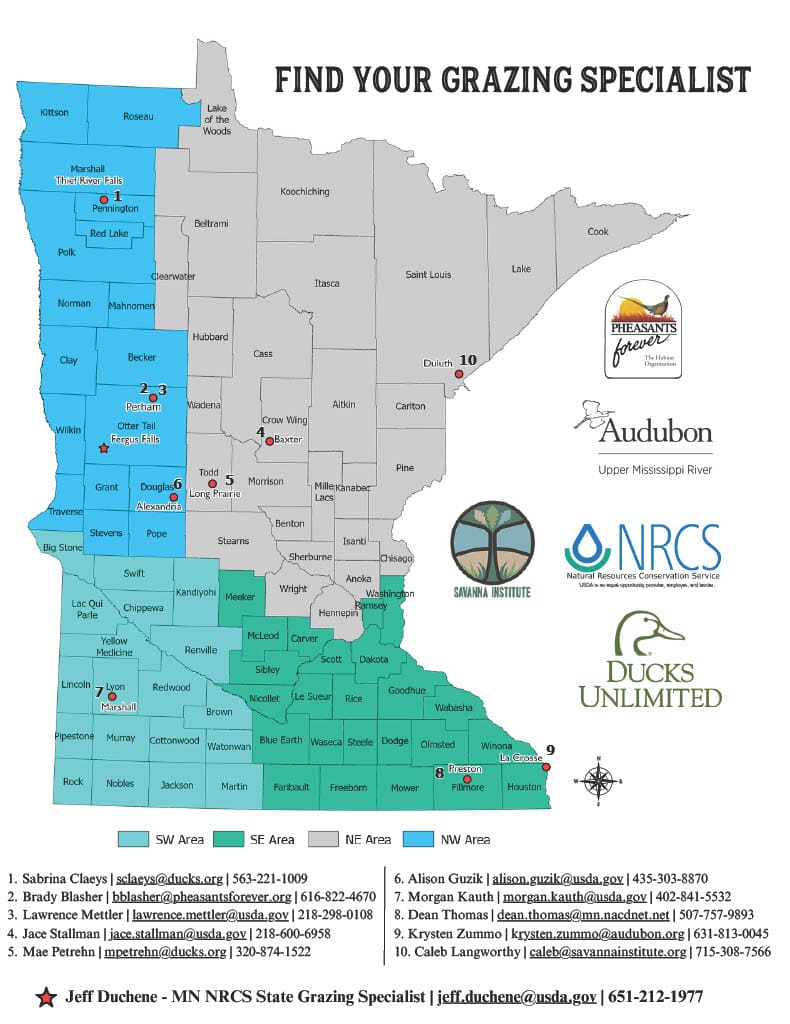
Jeff: They can reach out to any of us via phone call or email. They can contact me and I’ll refer them to the right person that can help. But a lot of times they start by contacting or visiting their local NRCS field office. USDA-NRCS has an office in almost every county, or some counties have a shared office between counties. We’re usually located in the same office as Farm Service Agency (FSA), so farmers can stop at FSA and then come visit NRCS to meet their local grazing specialist. If they run into one of us at a field day, we can give them a business card or give them the contact information for their local grazing specialist.
When producers come into our office, sometimes they’ll be referred to NRCS staff, or other times they’re referred to a grazing specialist that works for our partner organizations like Pheasants Forever, Ducks Unlimited, Soil and Water Conservation Districts or Savanna Institute.
What does a meeting with a grazing specialist look like for a producer?
Jeff: Typically a meeting with a grazing specialist happens at the farmers’ operation. They’ll have a conversation together to discuss the producer’s goals and objectives for their farm. They take a look at the land, pastures, and fields they’re interested in for grazing management. Depending on the producer’s starting point, they might have several meetings to discuss goals and make a plan. Some producers have an idea of what they want to do, and others don’t have ideas, so we’ll meet with producers as many times as they need to develop a plan.
After those initial meetings, we create a management plan to meet the producer’s goals which would include maps to layout the locations of existing infrastructure as well as the planned infrastructure and management practices. As the plan comes along, we meet more times to review and make changes to fit their needs. Throughout the process we’re always available to give assessments or bounce ideas off of.
How can a farmer plan ahead to get the most out of a visit with a grazing specialist?
Jeff: A couple thoughts- some producers we work with have a good idea of what they need help with, and some don’t which is fine too. You can be as little or as much prepared as you want.
But some general things that can be helpful for the grazing specialist to know are the producers’ goals and objectives, their current livestock management practices, which pastures they’re interested in improving, and the township section of the land they’re interested in making changes on so that they can make a map.
What are the benefits for a producer working with NRCS or partner grazing specialists?
Jeff: All the assistance we provide at NRCS is free- whether it’s a phone call, a field visit, or creating a management plan. All of the technical assistance is free. So that is the biggest benefit. I have producers that call me directly to bounce ideas off of me, and our grazing specialists are knowledgeable and can provide information to producers as well.
Another benefit is the programs we offer that can provide financial assistance for practices related to grazing management. Those practices include watering systems, pasture seeding, brush management, and a whole host of things. Our main financial assistance programs are Environmental Quality Incentives Program (EQIP) and Conservation Stewardship Program (CSP). These are totally voluntary, so producers don’t have to participate in programs to be able to get technical assistance, but they can apply to help with the cost of implementing practices. The best place to start would be your local field office to get more information.
What is a success story you’ve seen with grazing management?
Jeff: One particular operation I worked with about ten years ago was doing continuous grazing on all pastures and not providing any rest for the pastures. The pastures were over-grazed by the end of the season, and they also did not integrate the livestock onto cropland. With this management style they grazed for four months of the year from June till the end of September.
I started working with them to implement a rotational grazing system. That involved subdividing the pasture into several smaller paddocks to reduce the length of the grazing periods to a week or less, and giving each paddock adequate rest time so the forage plants can recover before being grazed again. They also started leaving adequate forage stubble behind when moving animals to ensure that enough plant material was available for optimum regrowth. As a result, the forage production improved.
They also started grazing crop residue and cover crops on the cropland to extend their grazing season. They went from four months to about seven or eight months of grazing during the year, and they were also able to increase their stocking rate. The main benefit of extending the grazing season is reducing production costs associated with winter feeding. The animals were able to harvest their own forage through grazing instead of being supplied with mechanically harvested forages, such as hay or silage. Overall, they took their operation leaps and bounds above what we started with, so it was one of the more exciting plans we’ve worked on.
What advice do you have for farmers who are just getting started on their soil health journey?
Jeff: I think the best advice I have is for farmers to educate themselves. Seek out information and advice, and ask questions from farmers that share your goals. There’s producers implementing soil health practices that are willing to share their experiences. And of course you have private, nonprofit, and agency staff that are willing to help educate, answer questions, and give technical assistance to producers. There’s also a lot of field days, pasture walks, and conferences that happen across Minnesota throughout the year, and that’s where you can get to know some of these people. Those events are a good place to start.
(Check out MFU’s Conservation Ag Events Tracker to find an event near you!)
The other piece of advice I have is to be persistent and adaptive. Sometimes things don’t work out exactly as planned, so try to reflect back to determine what changes need to happen to reach your objectives. Reaching out to other producers or technical staff can help you decipher why things didn’t work, so hopefully next time you have a better experience.
Interested in working with Jeff to find a grazier in your area? Connect with him at: jeff.duchene@usda.gov or (651) 212-1977
Conservation advisors work one-on-one with farmers to assess resource concerns and find opportunities for stewardship improvements. These advisors can be found at organizations across the state, from Extension offices to Soil and Water Conservation Districts to wildlife-focused non-profits. MFU regularly features conservation advisors to share how their assistance can support your farm goals. Read more in this series here.