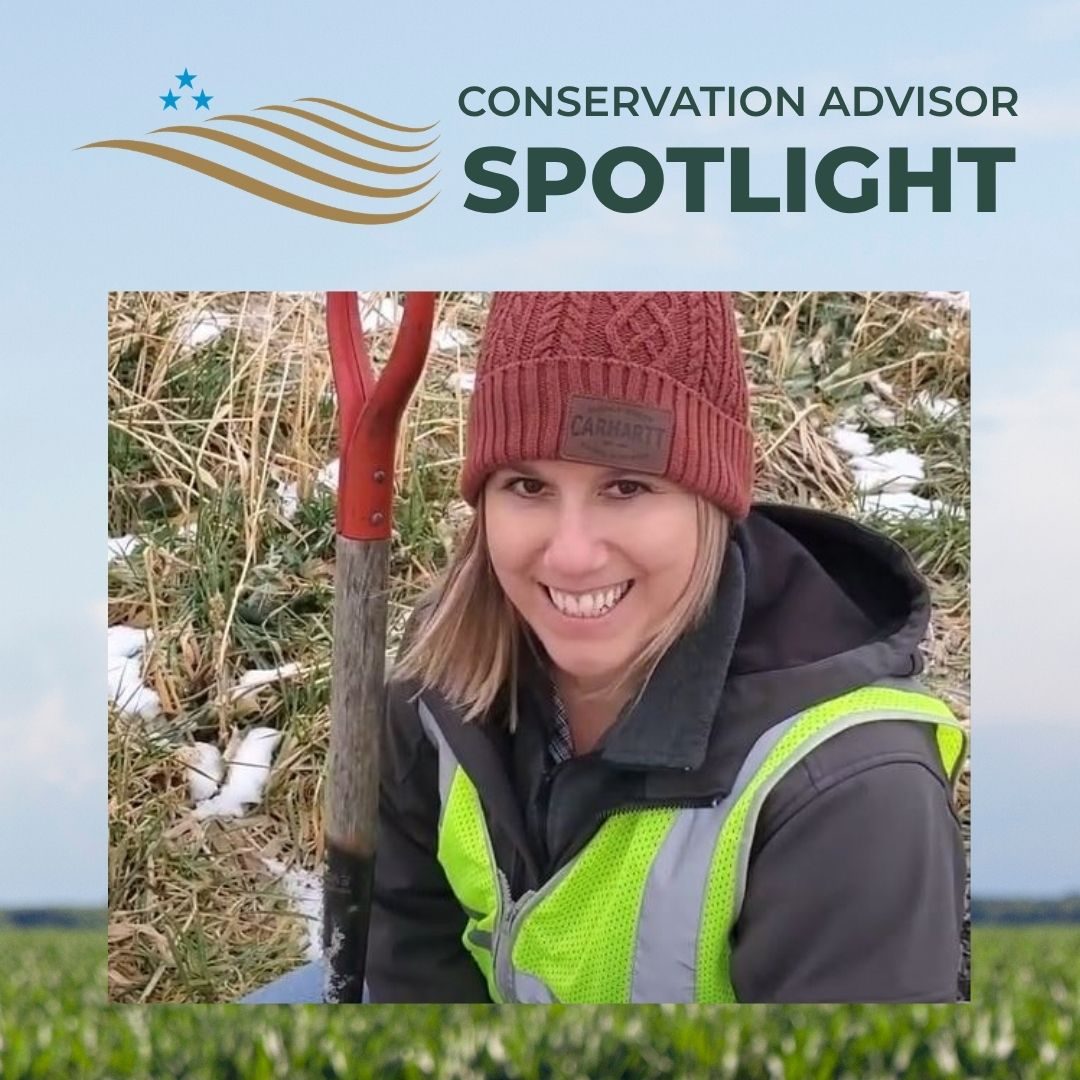
Holly Hatlewick: District Administrator for Renville Soil and Water Conservation District
In this regenerative farming space the culture feels far more supportive, and farmers are sharing lessons learned to help others not repeat mistakes they’ve made.
Holly Hatlewick
Holly Hatlewick is the District Administrator for Renville Soil and Water Conservation District. She has experience providing technical assistance for soil health practices such as reduced tillage, cover crops, rotational grazing, and perennial plantings. This interview has been edited for length and clarity.
What is your background?
Holly: I grew up on a farrow to finish swine and beef feedlot with corn, soybeans, oats and alfalfa near Marshall. I spent lots of time working on the farm with my dad and siblings and outside with the animals. That’s really what ensued my career path, my work now is a way to stay connected to farming. For my education, I have a bachelor’s degree in environmental science.
I spent about 15 years with Natural Resources Conservation Service (NRCS) as a district conservationist in South Dakota, and in Renville County for a stint. With NRCS I also served as a soil conservationist in South Dakota and across southern Minnesota. In 2016 I had the opportunity to come over to the Renville SWCD and I have enjoyed it.
Do you feel that your experience working in South Dakota informs your work here in Minnesota?
Holly: Yeah, tremendously. When I was with NRCS, it was a requirement to move to the county you worked in, and in hindsight that really provided a broader network of people that I still connect with and exposed me to so many different practices. The South Dakota counties I worked in as a District Conservationist were heavily grazing, but most of the cropland was reduced tillage, so working there also instilled my passion for reduced tillage and cover crops. Those experiences led us to start a reduced tillage and cover crop cost-share program here at Renville SWCD.
What types of conservation practices do you have experience helping farmers with?
Holly: In my previous roles and currently I do on-site inspection to help landowners set up practices on their land and do hands-on project implementation. I’ve helped farmers work through the practice standards from A to Z including reduced tillage, cover crops, rotational grazing, perennial cover, and windbreak design, to name a few. As a district conservationist I did oversight of that work and supervised installation. I have experience with both structural and non-structural practices.
What practices are you currently helping farmers with at Renville SWCD?
Holly: My role now is the district administrator of Renville SWCD, but I’m very fortunate that my board allows me to continue to foster my technical side by training our staff on soil health practices. If my schedule permits, I still work with farmers too because that’s my favorite thing. The most common non-structural practices our staff is assisting farmers with are no-till, strip-till, and cover crops. We also have the Reinvest in Minnesota (RIM) program and Conservation Reserve Easement Program (CREP) in Renville County, so we help people with pollinator establishments and perennial mixes for wildlife too.
What other type of support does Renville SWCD offer for farmers implementing conservation practices?
Holly: In 2016, we increased our outreach and support to farmers by starting an annual winter event to bring in speakers to talk about their experiences with soil health practices. We also started doing a field event in the fall to show farmers the implementation of the practices we talked about at the winter event. It’s been important to provide those opportunities for farmers to engage at different levels.
For equipment, we have a 10-foot Great Plains no-till drill available for rent. That piece of equipment has three different seed box options so people can seed a native planting, cover crops, or a cash crop like soybeans. Farmers pick up the drill from our office and operate it on their own, but we will meet them and talk through the logistics for calibration. We rent to farmers in Renville County as well as neighboring counties like Chippewa, Yellow Medicine, Redwood and Kandiyohi, as long as the farmer is willing to pick it up and transport it.
We also offer a drone seeding service. We started that in 2025 and since then have seeded Conservation Reserve Program (CRP) land with it, and also a lot of cover crops. We provide the pilot, the farmer works with us to get the seed, and then we come out and do the seeding for the farmer.
What types of extreme weather are farmers seeing in Renville County lately?
Holly: Last growing season, a farmer I know had 42 inches of rain during the year. Depending on which model you look at, that’s at least 10 to 12 inches over what is considered average, and those are the types of extreme weather swings that we’re looking at right now. If we can build soil structure to create water storage, that will really help farms build resilience.
Do you have any success stories of your time working with a producer on conservation practices?
Holly: A success story I want to share is about a customer that started coming to our winter workshops in 2016. They were always friendly, but they never really wanted to engage. One day in 2024 they came to us and said, “okay, I’ve been listening to the stuff you’re talking about and I’m ready to convert my farm”. I didn’t know their farm well but I had experience with equipment, so I started working with them on those cover crop mixes and equipment changes, and that farmer ended up converting 1,416 acres to 100% no-till and 100% cover crops. That’s been an example of a huge conversion we’ve done, and we realized that by hosting those winter meetings we were kind of passively setting them up for the transition, so that was really cool.
Another success story I want to share is from 2019, when we had a winter workshop and I did a slake demonstration. I was showing a conventional tillage system versus a soil health system with no-till and cover crops, and I had a farmer of 52 years pull me aside after the workshop. He said, “okay, you convinced me I need to do this. How do we do it?” I was surprised, but I worked together with him to make those changes which included switching from conventional tillage to strip-till. When he retired four years later, he made a requirement that his tenants continue implementing the practices that he converted to. For him to change after 52 years of farming was amazing, and it also shows that these practices and changes don’t have to be generational.
As far as the soil health benefits this farmer experienced, he shared with me that during his first year of strip-till there was a severe windstorm with 70 mile an hour winds that blew down his neighbor’s conventional corn, but his strip-till corn was still standing upright after the storm. It was a very visual way for him to understand that the strip-till corn had better soil structure compared to the conventionally tilled corn. Additionally, after just one year into strip-till, some significant ponding on low spots on his land was basically non-existent, showing that the soil had better water holding capacity from reduced tillage.
Do you have other examples of soil health benefits that producers have seen after just a year or two of implementing conservation practices?
Holly: Another example of a benefit you could see shortly after converting to soil health practices is a change in pests. I know a producer that had been spraying for aphids year after year, and just two years into a reduced tillage system, they didn’t have to spray for aphids because they had a healthier predator-prey balance in their soils by not breaking up the soil structure.
Another thing we see is a reduction of wind erosion, and there’s visual proof of that when you see white versus black snow in the winter. Growers have come in and said, “I’m going to keep doing cover crops because I can sleep at night seeing white snow in my ditch and knowing that I’m not moving those nutrients off my field.” I think those are really telling observations for farmers. Another producer was here a couple of weeks ago joking about how he’s going to keep doing cover crops to catch his neighbor’s soil when it blows across his field during the winter.
How have you seen farmers overcome the challenges that come with implementing conservation practices?
Holly: I observed early in my career that farmers would rather receive help from a neighbor or fellow farmer than the government. However, since conventional farming is a competitive for-profit business, communication sharing isn’t always encouraged and that becomes a barrier to learning. One of the ways that we’ve been helping farmers at Renville SWCD is through a peer-to-peer network. Connecting farmers with each other is huge, and I believe that’s what we need to do to break down that barrier. Whenever we can get a farmer in front of a group to talk we’re going to do that, and we also try to connect farmers with a neighbor because neighbors are very influential. Just a couple weeks ago we brought a map to our board to show the clusters of cover crop adoption throughout the county, and as SWCD staff we could look at the clusters and know which producers were the early adopters that influenced their neighbors.
In this regenerative farming space, the culture feels far more supportive, and farmers are sharing lessons learned to help others not repeat mistakes they’ve made. We have countless examples of meetings that ended at three o’clock, but at five o’clock we’re shutting the lights off and telling people they need to go home, because farmers want to stick around to talk to each other. We love it when that happens.
What would you say to a farmer that is concerned about return on investment for conservation practices?
Holly: I’d say it’s a long game. We have a farmer that has been fantastic at allowing us to share with people his current profit per acre versus his profit per acre when he was conventional, and we use those numbers to compare with Iowa’s custom rates as well. Additionally, we’re doing trials on some education plots and hope that in the future we can show local data about the return on investment for reduced tillage operations compared to conventional tillage.
What tools or resources do you recommend farmers use to help them implement conservation practices or be more resilient to erratic weather?
Holly: I would encourage people to build a relationship with their local SWCD. At Renville SWCD, farmers can opt-in to receive texts when we’re having events and we also post our events on our social media pages, so people can stay informed by following us there.
Another resource I recommend is the Midwest Cover Crop Council Guide, which is a great resource for selecting cover crop seeds. Both the Minnesota Soil Health Coalition and the Minnesota Office of Soil Health are groups that do great producer engagement as well.
What are you looking forward to in the 2026 growing season?
Holly: There’s many different things I’m excited about for the 2026 growing season. I’m looking forward to seeing the winter camelina we seeded in our education plot go to production, and we’re also planning to ramp up our drone seeding this year which is really exciting.
Additionally, we are working with Renville County on a drainage water management project to put in some temporary water storage and save soil from erosion. We’re looking at things like temporary ponds and deeper wetlands with water storage capacity to keep water and soil from flowing directly into the Minnesota River.
Lastly, we have nine CREP applications that were submitted by farmers recently and if those get funded, it will be fun to help landowners through that process of establishing plantings.
Interested in working with Holly or another staff member at Renville SWCD? Connect with Holly at: hollyh@renvilleswcd.org or 320-523-3636
Conservation advisors work one-on-one with farmers to assess resource concerns and find opportunities for stewardship improvements. These advisors can be found at organizations across the state, from Extension offices to Soil and Water Conservation Districts to wildlife-focused non-profits. MFU regularly features conservation advisors to share how their assistance can support your farm goals. Read more in this series here.