Swift County farmer changes his mindset and makes changes on the land
Harmon and Gina Wilts both grew up on farms in Swift County. Harmon was a technical agronomist with DEKALB/Asgrow until retiring in July 2022. He is also the Swifty County Farmers Union treasurer, on the Kerkhoven-Murdock-Sunburg School Board, a church trustee and on the board of the Chippewa Valley Ethanol Company. Gina is an elementary school teacher.
In 1999, they decided to start farming with the goal of keeping the land in the family and saving it for future generations. Today, Harmon and Gina farm 1,400 acres of corn, soybeans and sugar beets, and raise beef with their daughters in Swift County.
This conversation has been edited for length and clarity.
How has your farm structure changed in recent years and how are you planning for the future?
Harmon: In 2016 our three daughters Hannah, Katherine and Elizabeth became more involved in the farming operation and each bought 40 acres. Thanks to FSA (Farm Service Agency), they could get low interest, long-term payments and didn’t have to make a large down payment.
Our goal is to have a sustainable farm, meaning two things: the first is that the operation is financially stable in the long-term and the second is that the environment is being taken care of.
Has climate change informed your plans for the future of your farm?
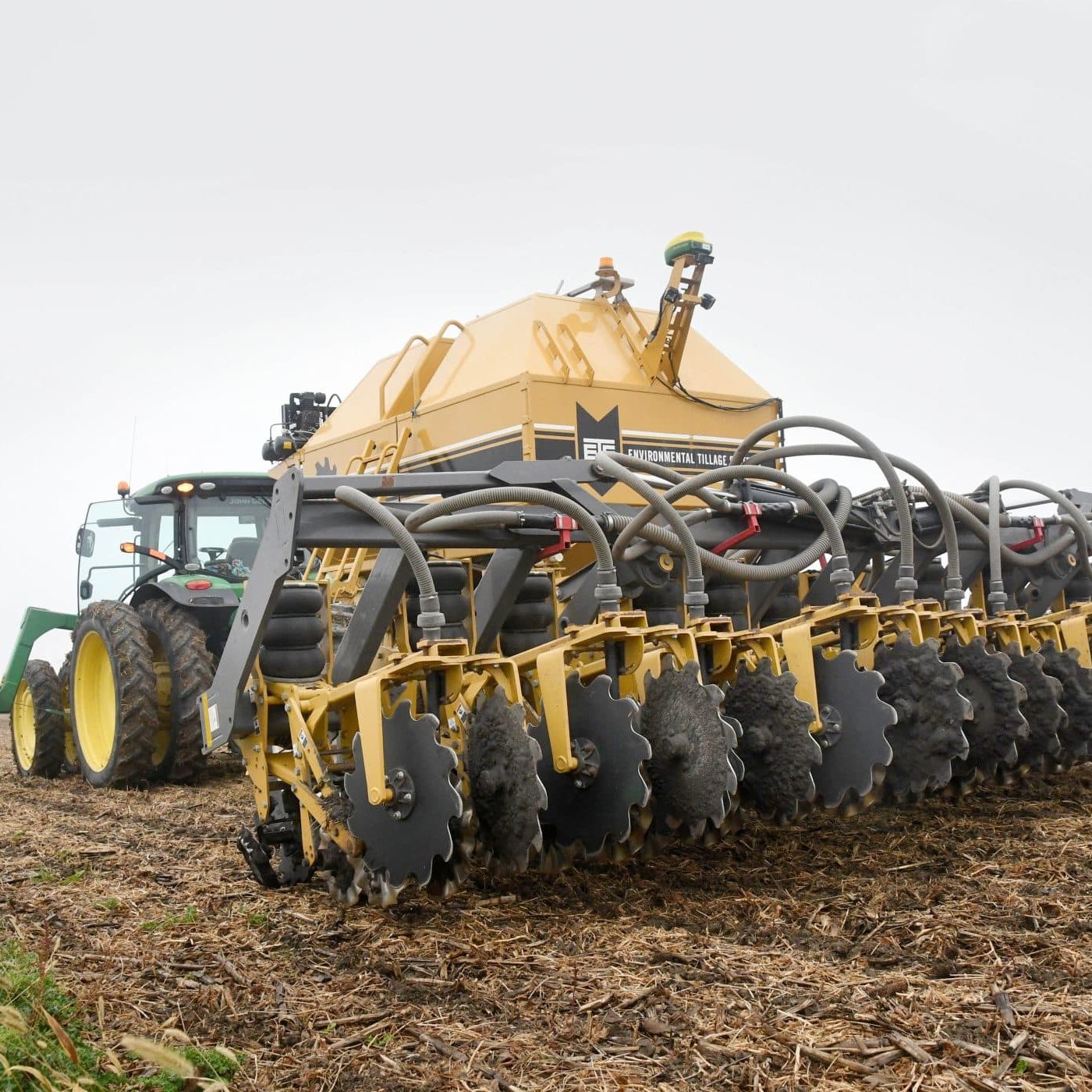
Harmon: Yes, it has. It started about five or six years ago, and we’ve made some changes like moving to a strip-till farming system in 2019. We till roughly an eight-inch band in the fall where we are going to plant the corn, beans or sugar beets. The fertilizer is also applied with the strip-till machine in the fall. We have all of our fields in a strip till system except for two this coming year, we have been working towards moving all our fields to strip tillage. We also became Minnesota Agriculture Water Quality Certified about a year ago.
If you take care of the land, it will take care of you. We knew we needed to take better care of our land to reduce water and wind erosion and to build soil organic matter. We took about four years to get better at conservation strip-tillage, and this will be our very first year implementing cover crops. The cover crops will follow 160 acres of soybeans and sugar beets across two fields that typically have more erosion challenges. There are definitely unknowns – we don’t know what the cover crop looks like, how to seed it, how to kill it, get a good stand, but that’s what we’re doing – it is a trial.
There were a few main areas of interest that led to our decision to try cover crops. Firstly, the potential to have cover crops help us with weed control. Secondly, improvements to soil porosity and tilth, building overall soil organic matter. Thirdly, it looks like farmers may be able to get a return on their investment through carbon credits.
Those are the angles we are looking at right now and we are working closely with our local NRCS office and co-op to figure out best management. We cannot afford to have a reduction in yield, so we are starting slower but at a decent scale.
What barriers do you see to the adoption of conservation practices?
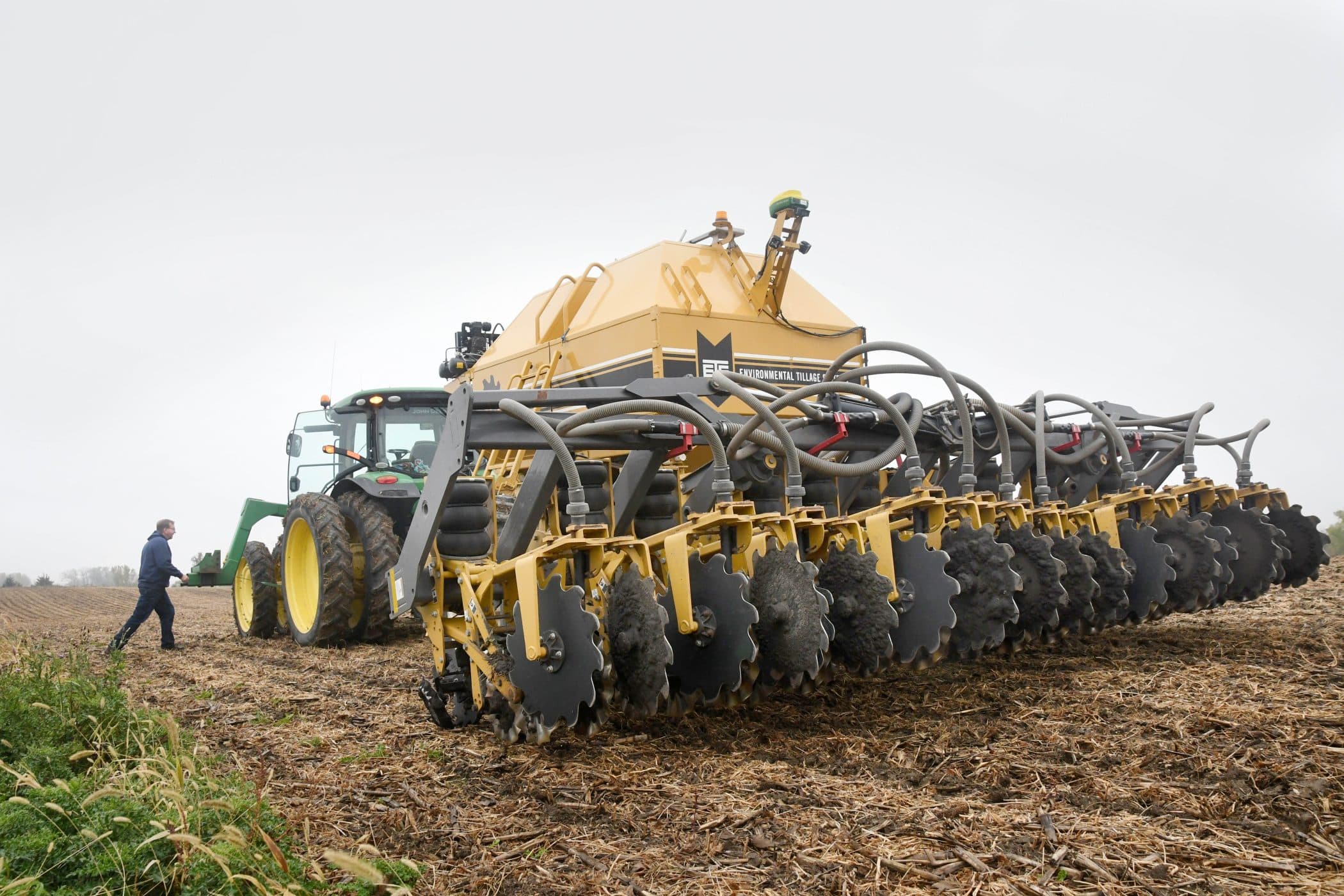
Harmon: One thing that jumps out as a barrier is the cost of equipment. For example, to get into strip tilling is a big deal – you need a great machine that will till and put the fertilizer on, and the tractor must have auto-steer. We have both sets of machinery right now, and someday maybe we can sell off our conventional machines. We are in the transition of making sure [strip tillage] really works for our operation.
The concern for large scale is that it takes more management. We started with three fields to learn the first years and worked our way up to the majority of our acres now. We need small and large farms to implement these practices to really make a difference.
Also, the risk. Where we live in Minnesota, we have to get the field to dry out so we can plant on time. If we plant late, we lose yield and have weed problems. The big risk to me is the question of if the field is going to dry out in time.
Another barrier that we struggle with living fairly far north is that the growing season window is short. Even if we want to do this, what if the weather doesn’t cooperate?
Access to land is also a factor. Landlords may think “oh what is that guy doing to his field; it looks different than someone else’s, is he doing a good job or not?” We own about half of our land and have been fortunate to have the support from our landlord after talking with them about conservation tillage. These are important conversations that need to be had.
As we get more into cover crops, the cost of seed gets higher and higher. The cost of implementing these things can be a challenge. Overall, you can look at these barriers as an excuse to never do anything, but we have decided that we need to learn about this as we go. We started with a couple fields, learned and grew. Let’s not let the barriers cause us to not do this, let’s start at a smaller scale and then learn and work our way up.
How has your family and farm operation remained resilient through these changes?
Harmon: As you make these changes you have to have faith. It is easy to quit and give up. Last fall, it was harder to make berms – they didn’t look as good, and the ground was really hard which made tilling challenging. So, we met out in the field and experimented running the machine on different settings. We knew we were getting some tillage done, not quite as good as we would have liked. We know that if we build berms it’s going to work. It sounds quirky, but having faith is key.
Our family had several meetings over the period of a year trying to decide if we wanted to [implement conversation tillage] or not. Honestly, it’s way easier not to do conservation tillage because the practice requires much more management. We really evaluated this and decided to go forward because it’s in our heart – we need to improve our soil, want to improve soil organic matter, and don’t want our soil to be blowing away. If we didn’t have the knowledge and faith, it would be pretty easy to quit.
What opportunities for advancing climate-smart agriculture through markets and policy have been on your radar?
Harmon: The path forward doesn’t seem really clear for us farmers as far as what opportunities there are. There has definitely been legislative that is positive, but how you actually get paid as a farmer is not clear yet. Take carbon credits for example, you don’t get any money unless you just started implementing carbon sequestering practices, well that really isn’t helping some of us that started several years ago. So that’s a challenge. We need a clear path forward on all the rules around carbon credits, this is up in the air and it’s tricky. This would help in planning for risk management.
How are companies going to get farmers on board? It will take more to move the needle than offering $10-20 per acre and telling farmers to change their lifestyle – it’s not enough incentive. For me, If I didn’t want to [adopt climate-smart practices] the money wouldn’t be enough to change my operation.
A beautiful sight for me used to be when the corn was about 12 inches tall, lush green and the soil was really black, now for me that is not beauty anymore. Now when the corn is about a foot tall and I have soybean residue in-between the rows and I don’t have black soil, to me that’s beauty. My mindset has changed.
If you could tell Congress to do one (or two) things that would help your family continue to farm in the next generation, what would it be?
Harmon: From my perspective, who is going to grow food in the future is really an issue. The bottom line is that we need to produce new farmers. Right now, land is selling between $9,000 and $12,000 an acre. There isn’t a young person that can buy this, so who is buying it? We talk about the big three in seed, big three in packers, and that’s a problem, we are also starting to see the big three farmers in each area out in the country, which is very concerning.
There’s a real opportunity for Congress to make legislation that puts more money towards incentivizing new and beginning farmers, and less towards more mature farms. Crop insurance is great, but it isn’t helping the young farmer on 40 acres, it’s helping me on 1,400 acres. I would much rather see a program helping young folks go forward. We really need to invest in the next generation of farmers.
From heavy rains to extreme drought and damaging winds, farmers are adapting and changing. The ‘Climate Resilience on the Farm’ series features Minnesota farmers who are using practices to make their farms more resilient as the climate changes. Read other articles in this series here.