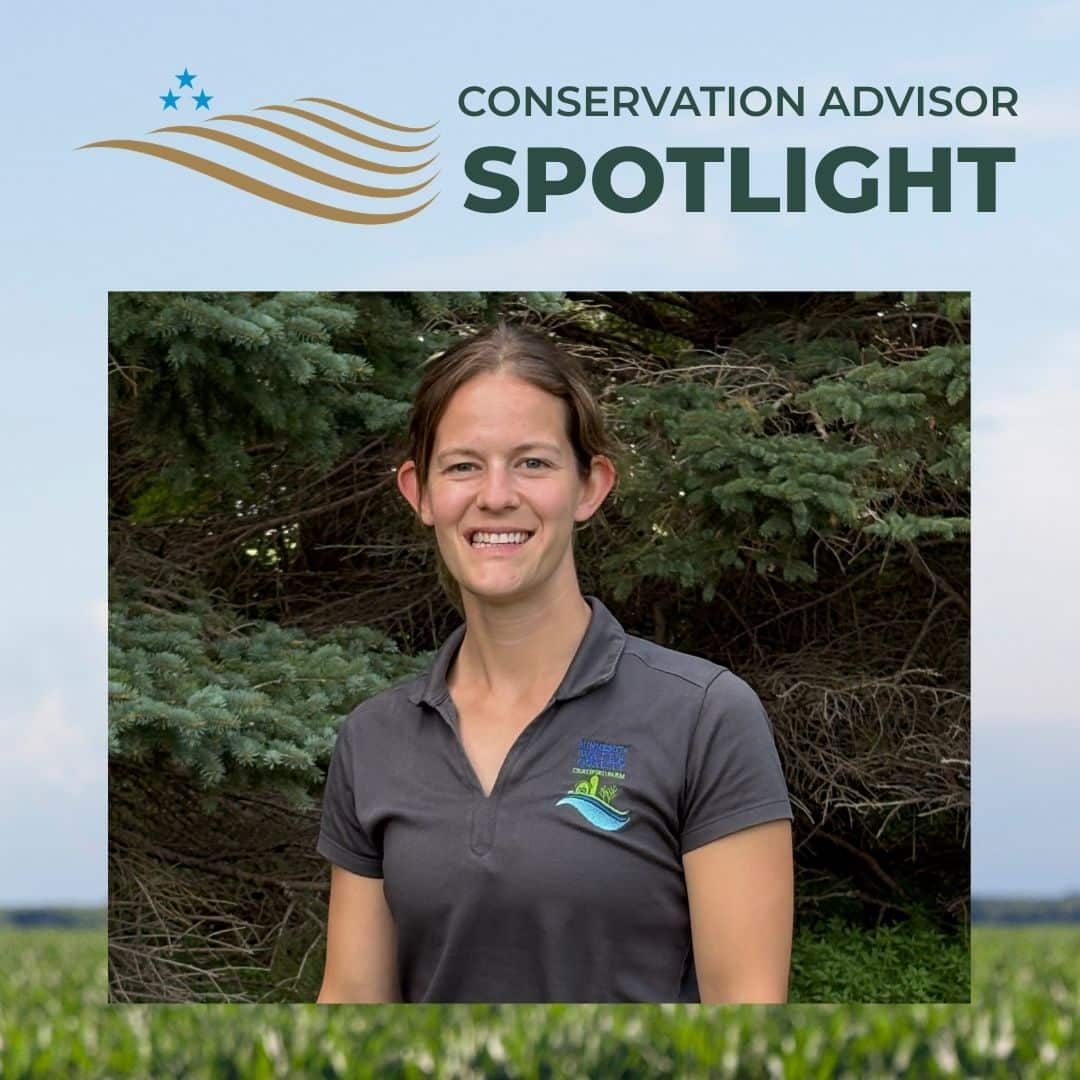
Danielle Evers: Certification Specialist for MAWQCP, Pipestone SWCD
I think the more proactive a farmer can be—especially in today’s world where consumers care a lot about sustainability—the better. This program [Minnesota Agriculture Water Quality Certification Program] gives farmers a chance to show they’re committed to that. It’s a way to change the narrative around agriculture and highlight the good work farmers are already doing.
Danielle Evers
Danielle is the Southeast Minnesota area certification specialist for MDA’s Minnesota Agriculture Water Quality Certification Program. She is based out of the Pipestone SWCD office. She serves landowners in 11 southwestern Minnesota counties: Cottonwood, Jackson, Lac qui Parle, Lincoln, Lyon, Murray, Nobles, Pipestone, Redwood, Rock and Yellow Medicine. This interview has been edited for length and clarity.
Can you share how you got into this role?
Danielle: I started off studying basic agronomy and agricultural science, thinking I might go into plant genetics—but then I realized I like to talk to people too much to work in a lab. One summer, I did an internship at a local soil and water office, and that really opened the door to this role. I’ve always appreciated the rural community. Agriculture feels like home to me, and I genuinely enjoy hearing farmers’ stories and learning what I can do to help them make the changes they’d like to see on their operations.
What are your areas of expertise?
Danielle: Nutrient management has become a real strength of mine. I focus a lot on how we can manage inputs like nitrogen and phosphorus efficiently to protect the environment while still staying profitable. I’d say my biggest strength is being able to look at an operation and dive into those nutrient decisions to make sure we’re getting the most out of them.
What does a typical visit with a farmer look like for you?
Danielle: I usually start by printing out all of their field maps, and we sit down together to talk through them. I’ll ask questions like: What does this field do for you? Do you have erosion concerns? Is your productivity where you want it to be? Any issues with tile intakes? Then we look at their soil tests and nutrient management records to see how they align with program guidelines. We also talk about their general management—tillage, nutrient application, conservation practices they’re using or interested in. I tie that all back to the field’s natural features like drainage and slope to figure out what’s realistic. For example, if a field is next to a river and on a slope, we’ll look at how to maintain productivity while also protecting that water source.
How can a farmer plan ahead to make the most of your visit?
Danielle: I like to send out a prep list ahead of time that covers the topics we’ll discuss. I ask producers to bring their soil test results. If they’re using fertilizer or manure, I ask for the total nutrient amounts, application rates, and any testing they’ve done. That helps me calculate nutrient availability and efficiency.
Once we finish the assessment, I put together a summary report for all their fields—where they stand in terms of eligibility, and if there are any changes they’d need to make to become certified.
What are the benefits of participating in your program?
Danielle: I think the more proactive a farmer can be—especially in today’s world where consumers care a lot about sustainability—the better. This program gives farmers a chance to show they’re committed to that. It’s a way to change the narrative around agriculture and highlight the good work farmers are already doing.
Some producers use certification for marketing, especially if they sell directly, but for larger corn and soybean farms, it’s less about marketing and more about being forward-thinking. It might hold even more value in the future, especially with things like carbon intensity scores becoming more important.
There are also direct financial benefits. We offer cost share—up to $5,000 or 75 percent—for farmers implementing new practices through the ag water quality program. And certification adds points when applying for other funding programs. For example, the Minnesota Department of Agriculture’s Soil Health Financial Assistance Grant offers up to $45,000, and being certified added 25 points to your application. Most people who got funded were certified. There’s also a regulatory benefit—certified farms are recognized by the state as having met certain resource protection standards. That means if new regulations come along, they may be grandfathered in since they’ve already met the bar.
What advice do you have for farmers just getting started with conservation or soil health?
Danielle: Don’t be afraid to look into the program. It’s voluntary, and it gives you a really good baseline. Even if you’re not planning on making a lot of changes, it’s helpful to know where you’re at. It’s also a third-party assessment you can take with you and use however you’d like. There’s no penalty if you go through the process and decide not to certify or make changes. That’s something I always try to emphasize—your information stays private. If you don’t get certified, it doesn’t go anywhere. That’s a big concern for farmers, and I totally understand. You’re sharing a lot of data with us, and you deserve to know it’s protected.
Interested in working with Danielle? Connect with her at: Danielle.evers@pcmn.us or 507.221.0304
Conservation advisors work one-on-one with farmers to assess resource concerns and find opportunities for stewardship improvements. These advisors can be found at organizations across the state, from Extension offices to Soil and Water Conservation Districts to wildlife-focused non-profits. MFU regularly features conservation advisors to share how their assistance can support your farm goals. Read more in this series here.