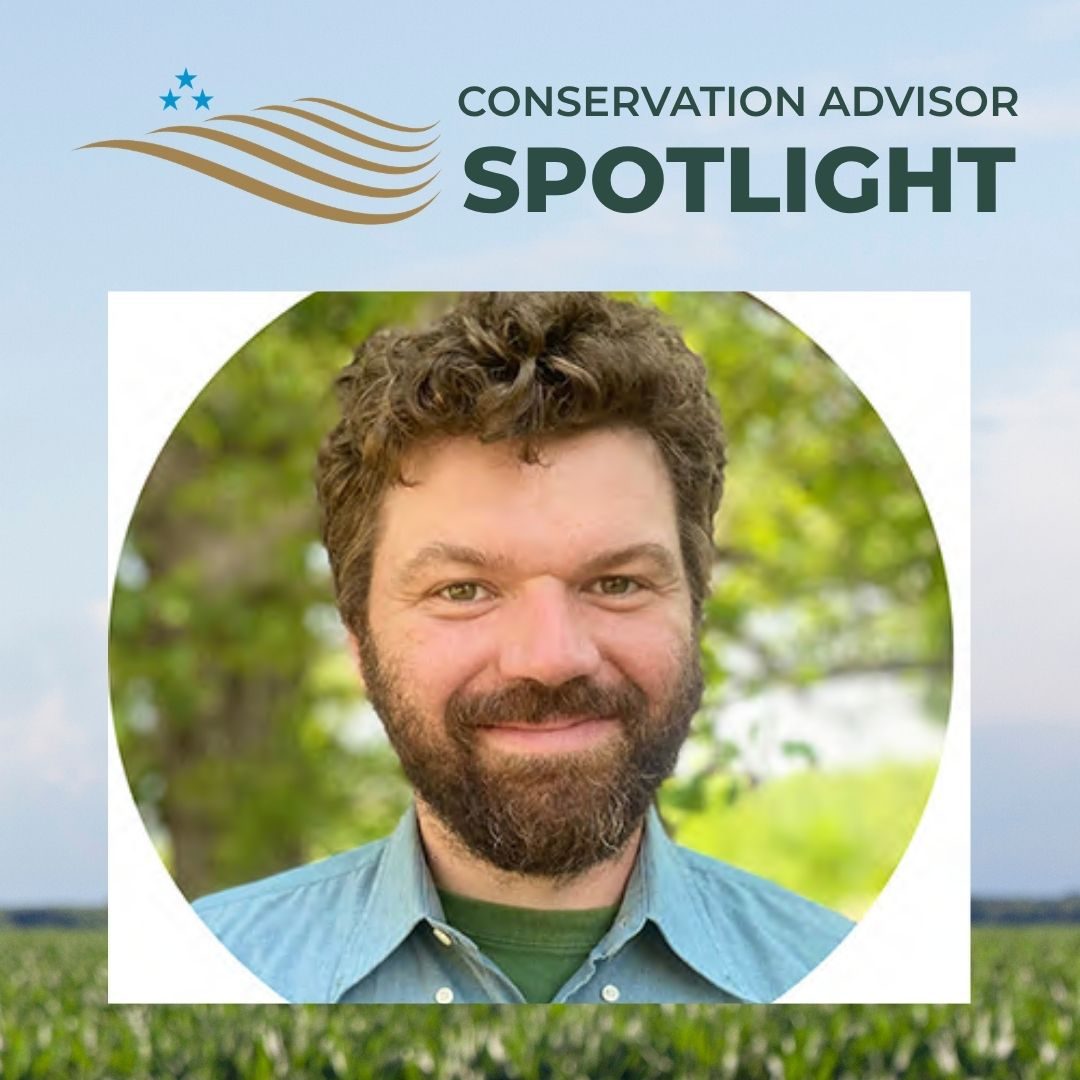
Caleb Langworthy: Agroforestry Technical Trainer at Savanna Institute
Silvopasture grazing systems are a great way to adapt to changing weather patterns. It allows farmers to incorporate trees into their grazing system to mitigate the effects of drought and heat.
Caleb Langworthy
Caleb Langworthy is an Agroforestry Technical Trainer at Savanna Institute. He specializes in providing technical assistance for agroforestry practices. He is based in Duluth and works statewide. This interview has been edited for length and clarity.
What counties are you working in?
Caleb: I work across the state of Minnesota, so sometimes I’m out in East Otter Tail County, sometimes down in Fillmore, or sometimes in Pine County. It all depends on where the interest is coming from.
What is your background?
Caleb: I’m originally from Lake City, MN. The first farm I worked on was right outside of town, I love bluff country so much! I received my bachelor’s degree in agriculture from Evergreen State College in Washington. When I came home, I taught high school in Rochester for a couple of years, and then my partner and I decided to start our own farm. With high land prices in southeast Minnesota, we bought our farm in western Wisconsin. There, we ran a CSA for a time but really leaned into a managed grazing operation with sheep and cattle. For a few years, I worked as a contractor for MOSES [renamed to Marbleseed], and then decided to jump into conservation planning full-time, so I took a position with the Savanna Institute in June of 2023. Initially, I was a technical assistance provider, and then I transitioned into my current role as an agroforestry technical trainer as part of a cooperative agreement with NRCS. Over the past few years, we’ve been able to grow our technical assistance from just me to three folks working in Minnesota.
My interest in silvopasture, an agroforestry practice, started with a degraded woodlot on my farm. I just kept thinking about how I was paying the overhead cost on the ground but it wasn’t providing any benefits to my grazing operation. So I looked for ways to add value to that unproductive ground, which was becoming increasingly degraded by buckthorn. I started rotating cattle through the degraded woodland to set back the buckthorn and establish forage, incorporating it into my overall grazing system. I also incorporated other agroforestry practices on the farm, like a small food forest around the homestead and a field windbreak.
What conservation practices are you most commonly helping farmers with?
Caleb: I work with agroforestry practices including windbreaks or shelter belts, riparian forest buffers, alley cropping, forest farming, and silvopasture. As we’ve grown our program at the Savanna Institute, we’ve expanded our agroforestry technical assistance to include forest and maple stand improvement, and grazing and brush management as well.
What is the difference between forest farming and silvopasture? What are the benefits of those practices?
Caleb: Forest farming involves establishing two production layers in the same area. So a forest farmer might have a maple stand and introduce an understory crop like ginseng or ramps into their forest. Another example could be a stand of red pine trees and lowbush blueberries. Shiitake mushrooms are another crop you could produce in a forested setting.
Silvopasture is all about managed grazing in woodlots, protecting trees while maintaining animal health and adequate forage. There is an unfortunate history of letting your cows out in the woods and set stocking them, which isn’t great for either forest health or animal productivity. Animals can overgraze the grass, and unmanaged animals also tend to pick a favorite tree, which can expose the roots and can cause the tree to die over time. In contrast, silvopasture aims to use the grazing animal as a tool to manage the landscape while also keeping the land in production for grazing. My work with grazing animals in woodlots focuses on managing the animals, the woodlot, and the forage appropriately so the system can be maintained over time.
Can you share a success story of your experience working with a producer on an agroforestry practice?
Caleb: Sure, recently I worked with a dairy farmer in East Otter Tail County; he was looking to provide some wind protection for his milking herd. We planned a shelter belt to provide wind protection around his barn and another windbreak to manage snow distribution along his farm lane. Most of my projects focus on integrating trees and crops successfully and having them play nice together.
In southeast Minnesota, a producer contacted me looking for advice on how to best manage his woodlot. After chatting about his goals, I realized that he actually had been collecting interesting hazelnut and chestnut genetics. I was impressed with his knowledge and conservation ethic. I told him about the breeding and commercialization work that Savanna Institute and Forever Green Initiative is doing, and that they are looking for farmers to establish some hazelnut demonstration farms in Minnesota. Now he’s planting part of his farm with improved hazelnut genetics, and his daughters could choose to take the land over in the future.
I’ve heard from a few producers that they are worried about the long-term stability of global export markets so they want to dip their toes into something they can market locally. It takes a long time and a lot of care and expenses to get to the point where shrubs and trees are producing, but growing something new like hazelnuts is a great way to diversify your operation and provide ecosystem benefits to your land.
It sounds like you work a lot with landowners who own forested land. Is there any practices that you can help a traditional row crop farmer with?
Caleb: Sure, I’ve worked with crop farmers who establish wind breaks around their homestead, grain bins and barn to get protection from the winter winds. Another agroforestry practice a row crop producer could benefit from is a forested riparian buffer planted adjacent to a field.
A less common practice for row crop farmers is alley cropping, where strips of trees are added into a crop field to provide an additional income opportunity and some windbreak benefit. More commonly, I see alley cropping being implemented with smaller specialty crop producers who are planting something like a hedge row or a strip of trees in between their vegetable fields. They could plant fruit or nut bearing shrubs like hazelnuts, raspberries, or currants for example, and direct market those alongside their specialty crop.
What type of extreme weather events are producers you work with experiencing?
Caleb: I think the number one thing I run across is drought periods that are lasting longer, and then when we finally do get rain it comes in infrequent and high volume precipitation events. I’ve seen producers find success utilizing silvopasture during what grazers call the ‘summer slump’, which happens from late July through August when the grass production slows down. In a dry year, farmers might want to take their animals off the pasture and feed hay during that time. Silvopasture, however, can provide a level of comfort to the livestock during this time because they have shade, and the cool season grasses can stay productive longer in that shady, moist environment. To me, silvopasture grazing systems are a great way to adapt to changing weather patterns. It allows farmers to incorporate trees into their grazing system to mitigate the effects of drought and heat.
Do you know of any networking or resource-sharing groups that help agroforestry producers stay resilient?
Caleb: The Crow Wing Forage Council is a great example of a networking group for farmers to connect with each other to stay resilient. The group is a project of the Sustainable Farming Association; they share resources, get together periodically, and visit each other’s farms to learn from one another. There is a lot of silvopasture practiced in that area. It’s great to see producers taking the lead and educating each other.
Land Stewardship Project also does a great job in southeast Minnesota getting folks interested in soil health together to talk about problems and solutions for their farms. Those groups are two examples of producers working together to solve on-farm issues.
What tools or resources do you recommend for farmers to help them implement conservation practices?
Caleb: Savanna Institute has a tool from a spinoff company called Canopy Farm Management. The Canopy Compass is a free tool to look at soils, weather, and cropping data to better understand where agroforestry crops might be suitable for your farm. It’s a high level tool that we use to start generating ideas. Farmers can use it too – it’s a really intuitive app.
What would you say to a farmer that is concerned about return on investment for agroforestry practices?
Caleb: Often times thinking about what the farm looks like for the next generation is the real push for agroforestry practices. For example, the project I mentioned earlier to plant a windbreak for the dairy farmer in East Otter Tail County will really benefit the next generation of farmers on that land. There are some agroforestry crops that can provide another stream of income, but those crops can take ten to fifteen years to start producing and the return on investment is longer still. With our current farm economy, it’s a stretch to have folks envision their farm twenty years from now when they are dealing with this year’s problems, so it’s worthwhile to take that into consideration. If I am working with someone in their 60s or 70s, they are often talking about stewardship legacy and the next generation. That’s helpful for me to know so we can bring the next generation into the conversation and get their input.
What have you learned about how to most effectively work with and support producers?
Caleb: I’ve learned to listen and develop relationships with producers over the long haul. During the initial site visit, sometimes I don’t get as far as I want to, but I’ve realized that listening to the producer and understanding their perspective is the most effective way to implement their goals because they get to choose what happens on their land and they know their farm more than I do. My role is to support them with good information and help them find resources to implement their goals.
I work across the state and the landscape is so diverse, so I tend to work at a high level. When I get onto the farm, the producer is the one that knows where their land is wet in the spring or where it dries out first, and where the old well is located or where there’s some fence hidden back in their woods. Ultimately the landowner is the guide and their goals are paramount to my work. I let them lead the way not only with their land but in their interests too. Some landowners are interested in specific things like adding biodiversity to their operation, producing a second crop, participating in a government program, or protecting water quality. There is nuance to planning and I’m there for it alongside the landowner.
What are you looking forward to in the 2026 growing season?
Caleb: At Savanna Institute, our Minnesota technical assistance team hired an awesome forester recently. I spent last fall training them and they’ve been travelling around Minnesota getting used to the landscape and meeting folks, I’m excited to see them go out and help producers. I’m also excited to have that added expertise on the team!
Interested in working with Caleb to incorporate agroforestry practices into your operation? Connect with him at caleb@savannainstitute.org or 715-308-7566
Conservation advisors work one-on-one with farmers to assess resource concerns and find opportunities for stewardship improvements. These advisors can be found at organizations across the state, from Extension offices to Soil and Water Conservation Districts to wildlife-focused non-profits. MFU regularly features conservation advisors to share how their assistance can support your farm goals. Read more in this series here.