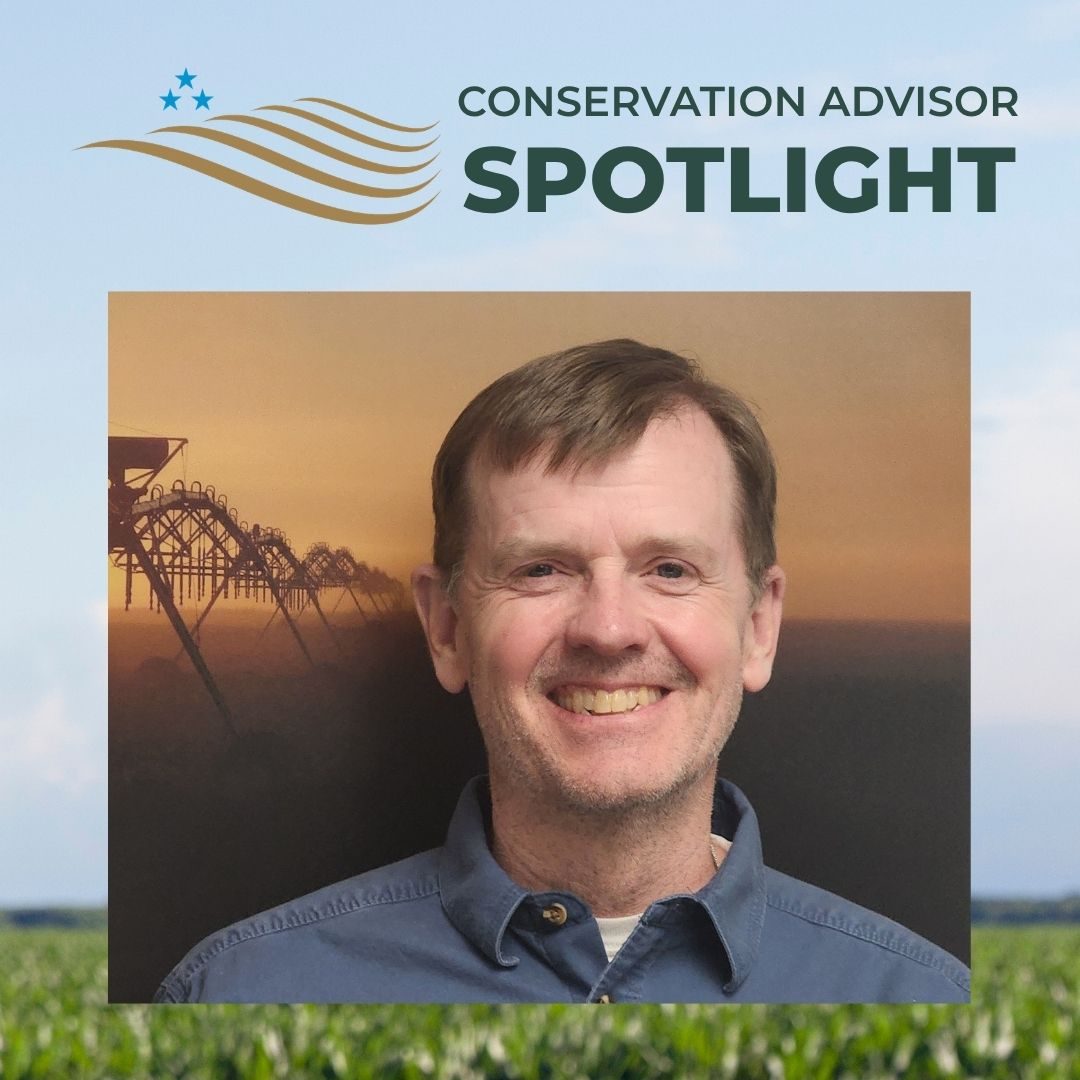
Bryan Malone: District Administrator at Becker SWCD
Overall I’d say just trying conservation practices is great. Trying something gets you experience to see what the benefits may be, and our cost-share programs can reduce the risk of trying a new practice like cover crops.
Bryan Malone
Bryan Malone is the District Administrator at Becker Soil and Water Conservation District (SWCD). He has been employed at SWCDs for over 30 years, and has a background in forestry. This interview has been edited for length and clarity.
What is your background?
Bryan: I grew up on a 250-acre dairy farm north of Wadena, and my hopes were to actually farm there but my allergies got so bad that I had to find something different. I got a degree in forestry from the University of Minnesota. Through my role with Soil and Water Conservation Districts, I still have a connection to agriculture and helping others, and the work touches on some forestry along with lots of agronomy.
I just celebrated 33 years in SWCD employment. I started out at Carver SWCD, then went to the Northwest Minnesota Technical Service Area after that, then spent 23 years at Pennington SWCD, then came here to Becker. I’ve been with Becker for five and a half years now. I remember being the young punk now I’m the old guy.
What is your role at Becker SWCD?
Bryan: The vast majority of my duties are grant, program, and personnel management. We have 14 staff here and there’s a lot of landowner interaction so I still get to do work with producers, just not as much as I used to.
An example would be last week when we assisted two landowners in connecting about retrofitting a conventional corn planter for no-till planting. Those producers met through a soil health event that we held in March. One farmer learned about what the other did with his planter and wanted to see it, so we facilitated that meeting to have the farmer show us his retrofitted planter. Making those connections between producers is one way we help them.
What does it entail to retrofit a corn planter for no-till planting? What is the purpose of doing that?
Bryan: Instead of having to make a large equipment purchase, it’s possible to purchase smaller parts to convert an existing corn planter for no-till planting. This particular producer had a dairy operation and also grows corn, small grains, and hay. In this case the farmer installed new coulters along with a row cleaner and packing wheels. All those small pieces of equipment made for a smaller investment to switch to no-till.
Does your SWCD offer a no-till drill that landowners can rent?
Bryan: We have a tractor and a no-till drill planter that our staff operates for no-till seeding around Becker County. It’s a ten foot no-till drill for cover crops and pasture interseeding. It is most commonly used for seeding native grass and Conservation Reserve Program (CRP) plantings, but is also used for pollinator plantings too.
What conservation practices do the staff at Becker SWCD commonly help farmers with?
Bryan: One of the most common conservation practices that we see landowners asking assistance for is water and sediment control basins. In the hilly landscape we have here, we’re able to assist with installation of tile to fix gully erosion. Getting tile in the ground is seen as a big benefit to the landowner. Embankments are then installed to create pooling areas with intakes to the tile. Those pooling areas are designed to hold water during storm events for 24 hours, which reduces peak runoff and erosion during storm events. That allows there to be little or no crop damage during storms, while also improving water quality in the region.
What is Becker County seeing in terms of extreme weather lately?
Bryan: It seems like rain events are larger and faster when they happen. For example, we might end up with three and a half inches of rain in three hours rather than 24 hours. The storms also seem a little more intense. However, weather patterns change and we only have weather records for a little over 100 years. We don’t know if this has happened before or not.
What programs for conservation are popular for landowners at Becker SWCD?
Bryan: Natural Resources Conservation District (NRCS) programs are popular because of our cooperation with that partner agency. The Regional Conservation Partnership Program (RCPP) has been very popular, and we also have farmers participating in Environmental Quality Incentives Program (EQIP) and Conservation Stewardship Program (CSP).
Through NRCS’s CSP and EQIP, water and sediment basins used to be the most popular practice in our county until a couple years ago. Today, there’s more focus on soil health practices like reduced tillage and cover crops into cropping systems.
At the SWCD we actually piggyback a lot of state funding on top of federal funding from NRCS. For example, the payments that NRCS offers for conservation practices through EQIP or CSP can be stacked with our cost-share programs so that farmers end up receiving payments of up to 75 percent the cost of implementation. It works out pretty nice and makes our state funding go further, while also helping the land owners get more incentives to implement practices.
What would you say to a farmer that is concerned about return on investment for conservation practices?
Bryan: I would say that it’s best to try it on a smaller field, or just one field, and to actually track the return on investment. Usually the argument against conservation practices is that they will cause a reduction in yield, but if you look at the return on investment it’s typically very comparable to conventional practices. You also don’t have to invest in new equipment, you could retrofit equipment, rent equipment, or even just hire someone to do one field with their equipment. There’s a few different options when looking at new practices.
Overall I’d say just trying conservation practices is great. Trying something gets you experience to see what the benefits may be, and our cost-share programs can reduce the risk of trying a new practice like cover crops.
Do you have examples of soil health benefits that producers have seen after just a year or two of implementing conservation practices like cover crops or reduced till?
Bryan: I think the short-term benefits that are overlooked are the reduction in inputs. Your yield may go down, but your costs go down too which changes your return on investment. That’s definitely something to consider.
Environmentally, it seems to take two to three years with these practices to see the soil structure change and get the microorganisms functioning well in the soil. However, farmers that have planted cover crops usually talk about improved tilth and equipment trafficability after just one year.
How does Becker SWCD facilitate farmer-to-farmer learning?
Bryan: Last year we did a Soil Health Bus Tour that had about 40 participants, half of which were producers. They all went out to North Dakota and checked out a few farms in the Red River valley that hosted us to talk about their soil health practices. It was a three-day event to visit a couple sites each day. We try to do an event like that every five years, but in the evaluation of the event there were lots of requests from producers to do that type of event every other year.
We also try to hold at least one Soil Health Roundtable each March. Those roundtables are designed for our innovators to share their experiences and challenges with conservation practices. We invite a small group of about a dozen farmers to participate so that people feel comfortable sharing. If the crowd is too big, not as many questions get asked. We also try to limit the number of staff there so that farmers are really learning from each other. We provide a topic and then let the farmers talk about what they have experienced with particular situations.
Our most recent roundtable in March was a Cover Crop Summit. We had three tables that each had a farmer who had planted cover crops, some of them with livestock integrated into the system. Those farmers shared their experience with grazing cover crops and the benefits of the practice. That led to discussion about certain considerations to make with cover crops, such as when to seed, what rate to seed, and the equipment needed. Our roundtables are a good opportunity to discuss troubleshooting some of the issues you might run into when starting some of those practices.
How can farmers in Becker County stay in touch with conservation opportunities and resources being offered at Becker SWCD?
Bryan: We post about our Soil Health Roundtables on our Facebook page. For people that have shown interest in soil health practices, we have their contact info and reach out to them with events. We also have an app that does text message blasts with a link to a flyer, which seems the most effective method to get the word out.
What are you looking forward to in the 2026 growing season?
Bryan: We recently worked with producers to put some acres into cover crops and no-till through RCPP, so I’m looking forward to hearing producers’ thoughts about how well those practices worked, and whether they had good experiences and are willing to try those practices again.
Interested in working with staff at Becker SWCD? Connect with Bryan at bryan.malone@co.becker.mn.us, or call their office at 218-846-7360
Conservation advisors work one-on-one with farmers to assess resource concerns and find opportunities for stewardship improvements. These advisors can be found at organizations across the state, from Extension offices to Soil and Water Conservation Districts to wildlife-focused non-profits. MFU regularly features conservation advisors to share how their assistance can support your farm goals. Read more in this series here.