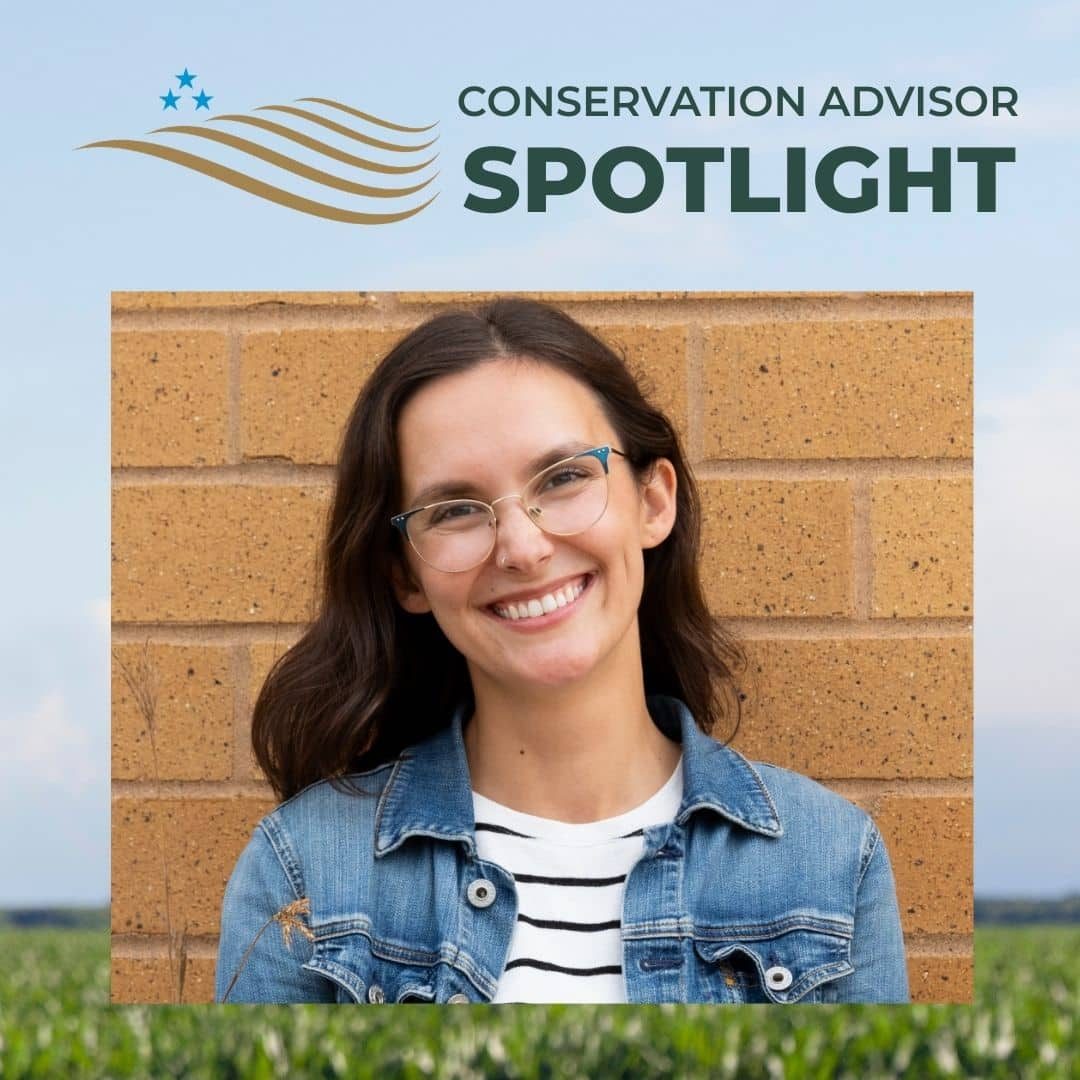
Natalie Hoidal: Local Foods and Vegetable Crops Educator at UMN Extension
Talking about climate change and extreme weather is important for farmers because it helps them not feel alone in those feelings of grief. Building community is as important, if not more important, than the strategies you choose for your farm.
Natalie Hoidal
Natalie Hoidal is a Local Foods and Vegetable Crops Educator for University of Minnesota Extension. She has expertise in soil health and nutrient management for specialty crop systems, including those with high tunnels. She is based in Dakota County and works statewide. This interview has been edited for length and clarity.
What is your background?
Natalie: I’ve spent a lot of time in vegetable production. I was involved on the student farm during college in Morris and I worked on a vegetable farm in grad school where I studied alternative cropping systems. I’ve spent the last eight or nine years working for Extension, most of the time in my current role working with vegetable farmers. Most of my work is collaborative and involves on-farm research.
What does your work with Extension entail?
Natalie: Part of my work with farmers happens through cohort programs. Our climate cohort program is a collaboration between Land Stewardship Project and Extension, and it involves a group of farmers that work together to develop climate resilience plans for their farms by identifying conservation practices and thinking broadly about community resilience, financial resilience, and protecting people. There’s a community of people who have already gone through the cohort that we still host get-togethers for, and we also regularly do new cohorts for the program. The program has created spin-off groups to educate about specific topics like fruit systems or grain farming.
I also teach courses for farmers like a 9-week introduction to high tunnels class, a vegetable production/crop planning course, and I teach a lot of sessions with beginning farmer programs.
The other part of my work is providing one-on-one technical assistance to producers. Generally I try to encourage people to get a hold of their county Extension educator before they contact me, because there’s only one of me and there’s lots of vegetable farms in Minnesota! A lot of counties across Minnesota have an agriculture, local foods, or horticulture educator, and that person has more capacity than I do for one-on-one farm visits to go through soil tests and provide other on-farm help. Farmers can look up their county name and UMN Extension to find contacts in their region online.
What conservation practices are you most commonly helping farmers with?
Natalie: I focus a lot on soil health and nutrient management. If you want to consider high tunnels a conservation practice, I do a lot of work with those as well. More broadly, I do work around climate resilience with farmers which entails finding ways to get support for extreme weather events like heavy rainfall and drought. So I do a little bit of everything.
Can you share a success story of your experience working with a producer on a conservation practice?
Natalie: One recent success involves my work with Julie Grossman’s lab on cover crops and high tunnels. A couple years ago I did a study looking at the soils in high tunnels on a hundred farms and I found that people struggle to maintain soils in high tunnels, so the soil often becomes dry and has imbalanced nutrients. We felt planting cover crops could help mitigate some of those challenges, and there’s plenty of research showing cover crops benefit high tunnels but not a lot of farmers use them there. The issue was that since cover crops are a relatively new practice, people wanted more direct support or to be part of a community to try the practice together. So we’ve been doing a project for the last year and a half for collaborative on-farm trials of cover crops in high tunnels.
For our trials, farmers got to choose from a few different legume cover crop species to plant during one of three times during the season–either in the fall for overwintering, in the springtime between their wintergreens and summer crop, or some farmers even volunteered to plant in the summer. Legumes are a cover crop that can add nitrogen into high tunnel soils without adding excess salts or phosphorus, and there are species that survive well through the winter in the warmer high tunnel climate. Once the farmers planted and grew the cover crops we got feedback about what did or didn’t work for them, and we got all those farmers together to get insights about what they learned overall. In total we had 45 farmers plant cover crops in high tunnels last year and almost all of them are planning to do it again, so I’d call that a success! At the end of this second year we’ll likely have more specific and clear recommendations for farmers based on all the feedback from those trials.
What types of extreme weather are producers you work with experiencing?
Natalie: All of it! For the last few years one of the hardest things for vegetable farmers has been Minnesota’s increasingly wet and cold spring. That’s a significant challenge for any type of farmer because it sets back your entire system.
We also have flash droughts and extreme heat in the summer, and night time lows are increasing to over 70 degrees, which makes it hard for plants to flower and set fruit correctly. Vegetable farmers work really hard outside every day, so they’re really affected by those hot days or the days with wildfire smoke, and it’s physically taxing on their bodies. There’s both acute stress and long-term burnout and exhaustion from working in those conditions every day.
How are you seeing farmers adapt to these extreme weather patterns?
Natalie: There’s lots of strategies for farmers to adapt to the extreme weather. One strategy is to shift the work day to start really early in the morning and finish in the middle of the day, or split the workday between morning and evening to get a break from the heat.
Another strategy is to use high tunnels to shift vegetable production into the shoulder seasons in spring and fall so that farmers aren’t relying on the hot summer months for all of their income. Even though the growing season is getting longer we still have a hard frost that can kill your crops, so high tunnels allow you to get through those cold nights. Shifting the workday and the growing season reduces risks, and balances labor and income.
What would you say to a farmer that is concerned about return on investment for conservation practices?
Natalie: In my experience a lack of motivation is not the problem and vegetable farmers aren’t hesitant to adopt conservation practices. For them it’s more about finding the time and figuring out how to do it. No-till is a good example of a practice I’ve noticed farmers wanting to try, but they have to figure out the challenges that come with it like managing weeds and major yield reductions. There’s a lot of financial and technical support available for conservation practices, and depending on your scale and system it’s not always a huge upfront investment so the major investment for vegetable growers is their time.
What tools or resources do you recommend for specialty crop farmers to help them implement conservation practices?
Natalie: There’s a really great community of practice in the Midwest for specialty crop growers to get together every month and learn from each other. It’s based out of Wisconsin and it’s called the Climate Resilience for Organic Vegetable Production group. We have a webpage about cover crops for vegetable farmers and some videos on small farms on the YouTube channel.
Extension’s Fruit and Vegetable Extension newsletter is also worth highlighting. Every week throughout the growing season we share detailed fruit and vegetable reports to talk about what we’re seeing out in the fields and what farmers should be thinking about. We highlight opportunities for conservation through the newsletter.
In general, I think talking about climate change and extreme weather is important for farmers because it helps them not feel alone in those feelings of grief. Building community is as important, if not more important, than the strategies you choose for your farm.
What have you learned about how to most effectively work with and support producers?
Natalie: I have learned that farming systems are really complicated, every farm is unique, and I rarely have all the answers. Because of that I’ve tried to build programs for farmers to learn and try things together for as many farms as possible. For example, we recently did a broccoli variety trial project because it’s getting harder to grow broccoli due to worsening threat of pests and diseases. We had 80 farmers trial planting different broccoli varieties on three farms, and they all had different results. So I like to think of myself less as a person with answers and more as a person who can provide opportunities and resources. But there are times when I can give really clear answers for things like high tunnels or interpreting soil tests.
What are you looking forward to in the 2026 growing season?
Natalie: So many things! I don’t know if any of these are funded, but I worked with quite a few farmers who submitted proposals for on-farm research for reduced tillage on fruit and vegetable systems. I’ve also been working with the MN Association of African Immigrant Farmers on trials to learn about West and East African crops like chinsaga, bitter leaf and cassava to grow them successfully in Minnesota.
At Extension we are also teaching a high tunnel class right now and we have a high tunnel available to us on campus in St. Paul to have fun with. We’ll have quite a few hands-on field days where people can come and practice high tunnel skills like pruning, trellising, and flipping beds for succession planting.
Interested in working with Natalie? Connect with her at: hoida016@umn.edu
Conservation advisors work one-on-one with farmers to assess resource concerns and find opportunities for stewardship improvements. These advisors can be found at organizations across the state, from Extension offices to Soil and Water Conservation Districts to wildlife-focused non-profits. MFU regularly features conservation advisors to share how their assistance can support your farm goals. Read more in this series here.