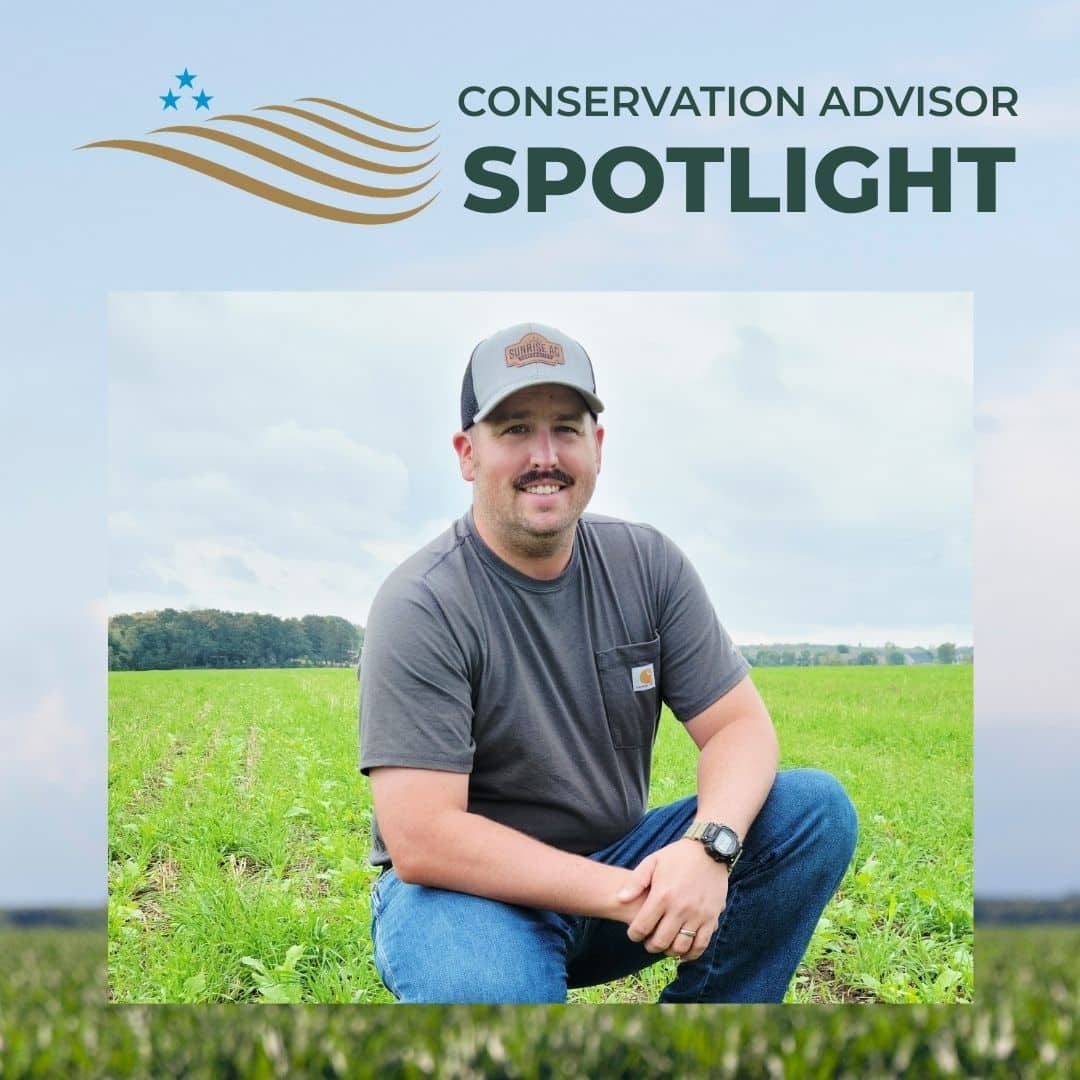
Alex Udermann: Farmer Mentor for Minnesota Soil Health Coalition
Conventional agriculture has taught us to farm a certain way for the last 50 years, often without much change. Regenerative farming works, and the soil health principles are real. Start small, keep moving forward, and stay patient.
Alex Udermann
Alex Udermann is a Farmer Mentor for the Minnesota Soil Health Coalition focusing on reduced tillage, cover crops and nutrient applications. He is located in Stearns County. This interview has been edited for length and clarity.
What is your background?
Alex: My name is Alex Udermann, and I’m a fifth-generation farmer at Meadowbrook Dairy Inc. where I farm alongside my wife, brother, and parents. We raise dairy cows, steers, corn, soybeans, small grains, and a wide range of cover crops. Our family is committed to regenerative agriculture, using 100% no-till planting, diverse cover crops, crop rotations, and precise nutrient, manure, and irrigation management.
How long have you been implementing regenerative practices on your farm?
Alex: We began transitioning to regenerative farming in 2017 with no-till soybeans and reduced tillage on corn. In 2021, after updating our equipment, we went fully no-till and have steadily expanded our use of diverse cover crops since then.
We’re now nearly ten years into this journey, and at this point we’re starting to dive deeper into soil biology by composting woodchips and looking at the soil biology under a microscope.
Along the way, my family has helped other farmers who want to try regenerative practices without the upfront investment in equipment. We provide manure hauling, no-till planting, and cover crop seeding. We’re also deeply involved in farmer-to-farmer education, regularly presenting at conferences and field days to share our experience with soil health and regenerative farming.
How did you become a mentor for the Minnesota Soil Health Coalition?
Alex: I have a huge passion for helping other farmers implement soil health practices. I first met Mark Gutierrez, the executive director of the Minnesota Soil Health Coalition, at a field day where I was presenting on planter setup and serving on a farmer panel about no-till and cover crops. That’s when I learned about the Coalition and the resources they offer farmers. At the time, I was looking for other producers in my area to network with and learn from because we were struggling in a few areas on our farm. I shared some of those challenges with Mark, and he encouraged me to start attending Coalition events.
I went to several of their events and quickly built connections with mentors and farmers, which helped us continue advancing our farm’s soil health practices. Over time, the Minnesota Soil Health Coalition and our farm have co-hosted field days and presented at conferences together. I became a mentor and then was hired as a part-time contractor for the Coalition to provide farmer-to-farmer education and support.
How does the Minnesota Soil Health Coalition farmer mentor program work?
Alex: Our mentors are farmers who volunteer their time to educate other producers about regenerative farming practices. That can include picking up the phone to share their firsthand experiences, what has worked well for them, and providing guidance to other farmers. We have over 50 mentors across Minnesota, and our goal is to be a reliable resource that farmers can contact any time of year with questions related to regenerative practices.
The mentorship program is like one big family. I focus on no-till, cover crops, and manure management—the areas where I can provide the most guidance. Other farmers might want to learn about strip-till, specialty crops, grazing, or other practices, and we have mentors in our network experienced in those areas. If I can’t answer a question, I’ll find someone in the mentorship program who can assist you. There are very few questions we can’t answer for a farmer.
Does a farmer need to prepare beforehand or bring anything to a meeting with a Minnesota Soil Health Coalition mentor?
Alex: No preparation is required. Our mentors are open books and conversations are low-key and politics-free! We do recommend bringing a notebook with any questions you have and a pen to write down answers and key takeaways. That way you can take notes back to your farm for implementation and share them with your family.
How can a farmer connect with a mentor from the Minnesota Soil Health Coalition?
Alex: Farmers can visit our website at www.mnsoilhealth.org to explore our resources, on-farm research, and farmer-led data. You can also email our Executive Director, Mark Gutierrez, at mark@mnsoilhealth.org, or call or text him at 505-980-1360. Mark will take the time to listen to your goals and challenges and then connect you with a farmer mentor who is relatable and experienced in the areas you’re seeking help with. You can communicate directly with your mentor by phone, text, or email to discuss specific practices and challenges.
We also encourage farmers to become members of the Minnesota Soil Health Coalition for access to our farmer mentor map that lists mentors, their locations, and their areas of expertise. Members receive discounted registration for field days, conferences, and educational events hosted by the Coalition, as well as discounts from manufacturers and dealers within our supporting network. In addition, members get our monthly newsletter with updates on soil health initiatives, upcoming events, and information on cost-share programs and private funding opportunities from businesses that support the Coalition’s work.
How can a farmer get in contact with you to work together?
Alex: Farmers can reach out to me in whatever way works best for them—by email, phone call, text, or Facebook message through our farm page, Meadowbrook Farm. You can also visit our website at www.meadowbrookfarmdirect.com to learn more about our operation and contact us directly through the site. Once we’re connected, we’ll guide you through a practical transition that fits your farm and goals.
Do you visit other farmers’ operations or host them on your farm to teach them about your regenerative practices?
Alex: It really depends on what the farmer is looking for. Most of the time working together starts with a short, casual conversation, but that can turn into a few hours of in-depth conversation if someone wants to dig deeper. However, I’m a big believer in getting boots—and a shovel—on the ground, so I always encourage farmers to visit our farm to see our equipment setup and healthy soil in real time. If a farmer is in my local area, I’m also open to visiting their operation, whether they want to show an area of concern, talk through equipment or management decisions, or get help understanding what’s happening in their fields.
If a farmer wants to learn about regenerative agriculture at in person events more generally, I encourage them to attend one of the 70+ field days the Minnesota Soil Health Coalition hosts each year, or the Coalition’s Premier Soil Health annual event in December.
What regenerative practices have been most successful for you?
Alex: Early on, no-till soybeans were a home run for us. They’re forgiving and a great place to start with regenerative practices. We were able to no-till soybeans using our existing equipment, without making any major financial investments.
Reducing tillage on our corn acres came next and was also a fairly easy transition. We parked the chisel plow and field cultivator, quit rock picking, and moved to minimal disturbance—typically just a light disc pass where needed during the early transition. By reducing tillage we dramatically cut diesel use and equipment wear and repair costs. We went from nine field equipment passes down to just two or three, with each pass costing roughly $10–$20 per acre. Over time, those savings really added up.
Eliminating rock picking alone saved us significant time and labor, and in combination with reducing tillage we’ve gained nearly two weeks of time in both the spring and fall. That extra time allows us to better manage our farm and reduces stress during planting and harvest.
From our practice changes we’ve seen our grain and forage quality improve, and we’ve seen our animals become healthier and more energetic, with increased production and quality of meat and milk, and significantly fewer veterinary expenses.
Longer term, as we fully transitioned to a no-till system and consistently integrated cover crops and improved manure and nutrient management, we’ve seen major soil health improvements. Our soils now have stable aggregates, earthworm populations of roughly 1.5 million per acre, faster water infiltration, enhanced nutrient cycling, and little to no soil erosion. With manure and nutrient management working alongside natural nutrient cycling, we have eliminated all dry commercial phosphorus and potassium fertilizer applications, resulting in a $35-per-acre savings. Most importantly, we’re seeing more profit per acre with fewer inputs. It truly snowballed over time—starting small, building momentum, and now it feels like an avalanche of improvements in both soil health and farm finances.
What advice do you have for farmers who are just getting started on their soil health journey?
Alex: First, have a clear reason why you want to make the transition. Whether it’s erosion, lack of labor, financial pressure, or something else, you need a purpose that drives the desire to change. For many farmers, including my family, it starts for financial reasons, but as you begin to see improvements in your soil, that motivation quickly shifts toward long-term soil health and resilience. Once you get “bit by the soil bug,” it’s easy to nerd out and keep pushing forward with new ideas.
Next, take the time to educate yourself. Understanding the five soil health principles and why they matter is critical. Our farm is almost ten years into this journey, and I still attend conferences and field days annually. Continued learning and networking is essential!
It’s also important to recognize that this transition takes time. You can’t move from a conventional system straight into no-till and cover crops overnight. New management challenges will come up, and the soil itself needs time to heal. For us, about five years of no-till soybeans and reduced tillage on our corn acres gave both us and the soil time to adjust.
Having everyone on board is another key piece. Your family needs to support what you’re doing, and it’s important to communicate with your landlord why you’re transitioning to regenerative practices. Bring your co-op and agronomists into the conversation as well, because nutrient management, herbicide choices, and application timing will change as your system evolves.
We felt pretty alone at the beginning of our journey, so I strongly encourage farmers to find a mentor or a trusted neighbor to lean on for advice. That’s one of the things I really appreciate about the Minnesota Soil Health Coalition—we have more than 50 farmer mentors across the state who help farmers avoid costly mistakes and shorten the learning curve.
I also recommend taking advantage of financial assistance and cost-share programs, such as those offered through the Natural Resources Conservation Service (NRCS), the Minnesota Ag Water Quality Certification Program (MAWQCP), or private funding sources. These programs can help reduce financial risk as you try new practices or retrofit and update equipment.
Overall, don’t be afraid to try things. Keep an open mind and think outside the box. Conventional agriculture has taught us to farm a certain way for the last 50 years, often without much change. Regenerative farming works, and the soil health principles are real. Start small, keep moving forward, and stay patient. I like to pick one or two new practices each year and give them 110 percent effort.
Interested in working with Alex to improve your reduced tillage, nutrient applications, or cover crops? Connect with him at? udermann3@gmail.com or 320-333-6110
Conservation advisors work one-on-one with farmers to assess resource concerns and find opportunities for stewardship improvements. These advisors can be found at organizations across the state, from Extension offices to Soil and Water Conservation Districts to wildlife-focused non-profits. MFU regularly features conservation advisors to share how their assistance can support your farm goals. Read more articles in this series here.